


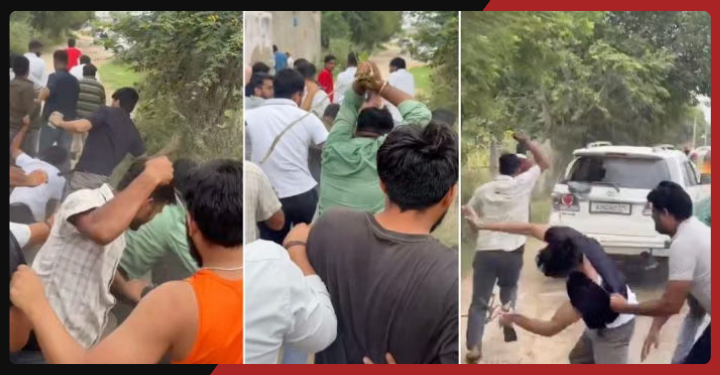
The Cockroach Janta Party’s campaign to inspect government schools in Rajasthan took a dramatic turn on Friday when CJP co-convenor Ashutosh Ranka and other members alleged that they were attacked while visiting a school in the Jaipur district. The incident has intensified the confrontation between the organisation and the Rajasthan government over the “School Thik Karo” campaign, which aims to highlight alleged deficiencies in public-school infrastructure.
CJP founder Abhijeet Dipke said that Ranka and other volunteers were assaulted during the visit. He accused people allegedly linked to the BJP of attacking the CJP team and questioned why police officers did not prevent the confrontation. The accusations have been widely circulated through social media posts and videos released or shared by the organisation.
The visit reportedly took place in the Rampura-Kanwarpura area. Ranka told reporters that the team wanted to inspect a government school whose condition had been a subject of concern. According to his account, the school had allegedly been operating from a buffalo shed for several years. CJP has argued that documenting such conditions is necessary if government authorities are to be held accountable for providing proper educational infrastructure.
But the visit reportedly met strong resistance from local residents. Video footage from the area shows people confronting and chasing CJP members. Reports also say that vehicles were damaged during the confrontation. The incident escalated into allegations of physical assault, although different accounts have emerged about who initiated the confrontation and why.
Ranka has alleged that the attackers were politically motivated. The CJP has connected the incident to its broader criticism of the Rajasthan government’s handling of school infrastructure. The organisation has also accused state Education Minister Madan Dilawar of political responsibility, although such accusations are allegations from the CJP and do not establish that the minister directed or participated in the incident.
The Rajasthan government and local residents have offered a contrasting context. Some villagers reportedly opposed the CJP’s presence and argued that the organisation was politicising a local school issue. Residents also said that funds had already been sanctioned for development work at the school. According to reports, approximately Rs 12.5 lakh had been approved for the institution.
The confrontation is particularly significant because it follows a recent government order restricting unauthorised access to government-school campuses. Rajasthan’s education authorities said outsiders must obtain permission before entering school premises and that photography, videography, interviews and live-streaming involving students and teachers require authorisation. The department cited student privacy, dignity and safety as reasons for the restrictions.
CJP, however, has interpreted the restrictions differently. The organisation has argued that the new rules could make it harder for citizens to document problems in government schools. Its campaign has encouraged volunteers and residents to identify schools suffering from poor infrastructure and submit information about the conditions.
The clash therefore represents more than a disagreement between one political organisation and a group of villagers. It has become part of a broader debate about transparency in public education. Government schools are public institutions, but they are also environments where children’s privacy and safety must be protected.
The challenge for authorities is to balance these two principles. Independent scrutiny can draw attention to genuine problems, while unrestricted filming or political activity inside schools can create privacy and security concerns.
The incident also highlights the importance of establishing facts through an impartial investigation. Allegations of assault, vehicle damage and political involvement should be examined through police records, eyewitness accounts, video evidence and statements from all sides.
Until that happens, the competing claims remain part of a politically charged dispute.
What is clear is that Rajasthan’s school-inspection controversy is growing. CJP says it will continue its campaign, while the government has strengthened restrictions on outside access to schools. The latest confrontation could determine whether the dispute moves toward dialogue and inspection through official channels or develops into a larger political conflict across the state.