


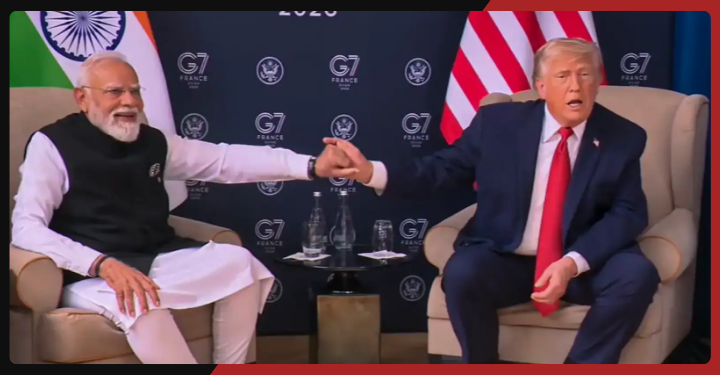
A new international dimension has emerged in the American debate over election rules after President Donald Trump invoked India’s electoral system while demanding stricter voter-identification requirements in the United States.
Trump’s latest comments focus on a basic difference between the two electoral systems. India has a nationwide system of voter identification, while voting requirements in the United States differ from state to state. Trump argues that America should adopt a stronger and more uniform system.
According to Trump, India’s Chief Election Commissioner Gyanesh Kumar recently questioned how American elections could take place without mandatory photo identification. Trump highlighted that exchange while urging Congress to pass the SAVE America Act.
The comparison has particular political significance because India is the world’s largest democracy and conducts elections involving hundreds of millions of voters. Trump cited approximately 646 million voters in India’s latest general election and pointed to the limited use of postal voting as another feature of the Indian system.
For Trump, the message is straightforward: if a country with such a large electorate can require voters to establish their identity, the United States should be capable of doing the same.
The SAVE America Act is at the centre of this campaign. The legislation seeks to amend federal voter-registration rules to require documentary proof of US citizenship. The White House describes voter identification and citizenship verification as essential safeguards for American elections.
The debate, however, is more complicated than simply comparing voter cards.
India has a central election authority, the Election Commission of India, which oversees elections under a nationwide constitutional framework. The United States has a federal structure in which states retain substantial authority over election administration.
This means a policy that appears straightforward from the Indian perspective can become constitutionally and politically difficult in America.
The US already has voter-identification requirements in various forms. But the type of identification required, whether alternative documents are accepted, and the procedures for voters who do not possess identification can vary by jurisdiction.
Trump’s proposed national approach would attempt to establish more uniform requirements for federal elections.
Supporters argue that standardisation would strengthen public confidence and reduce opportunities for irregularities. They say voters should be able to demonstrate that they are eligible citizens before participating in federal elections.
Opponents worry that additional documentation requirements could create obstacles for eligible voters. They argue that some Americans may not possess passports, driver’s licences or other documents that could easily satisfy stricter federal requirements.
This disagreement has turned voter identification into one of the most politically sensitive election issues in America.
Trump’s decision to point specifically to India is therefore significant. Rather than presenting voter ID merely as an American conservative policy, he is framing it as an international democratic standard.
His comments have also received support from US Ambassador to India Sergio Gor, who argued that the scale of India’s elections demonstrates that voter identification can be implemented even when hundreds of millions of people participate.
At the same time, the comparison should not be interpreted as meaning that India and the United States have identical electoral procedures. Their constitutional structures, voter-registration systems, election administration and voting methods are different.
Nevertheless, Trump’s remarks have created an unusual political connection between New Delhi and Washington. India’s voter-identification system has now become part of the debate surrounding the future of American elections.