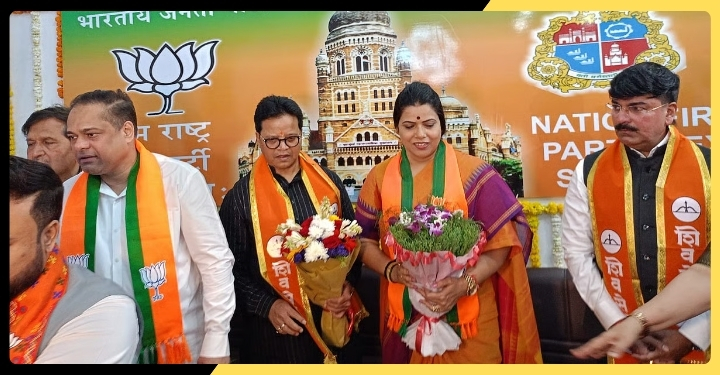
Mumbai is set to witness a major political shift in its civic leadership as the Bharatiya Janata Party (BJP) prepares to assume the mayoral post of the Brihanmumbai Municipal Corporation (BMC) with the nomination of Ritu Tawde. The development marks the end of Shiv Sena’s uninterrupted 25-year dominance over the city’s most influential civic position, signaling a decisive change in Mumbai’s political landscape.
For decades, the Shiv Sena had treated the BMC — Asia’s richest municipal body — as its political bastion. Control over the mayor’s office allowed the party to shape civic policy, influence urban development, and maintain a strong grassroots connection with Mumbai’s electorate. The BJP’s emergence as the new power at the helm therefore carries both symbolic and practical importance, redefining power equations in Maharashtra’s capital.
A Turning Point in BMC Politics
The change in leadership follows the results of the recently concluded BMC elections, which restored an elected civic body after nearly four years of administrative rule. The BJP emerged as the single largest party, giving it the numerical edge needed to stake claim to the mayor’s post with the support of alliance partners.
While the Shiv Sena continues to remain a significant force within the corporation, internal divisions and shifting alliances weakened its long-standing grip on the mayoralty. The BJP’s organisational strength, campaign strategy, and consolidation of votes across wards ultimately enabled it to cross a political threshold that had eluded it for a quarter of a century.
Political observers see this moment as more than a routine electoral outcome. It represents the BJP’s steady expansion from state and national dominance into the domain of local self-governance — a space traditionally shaped by regional parties like the Shiv Sena.
Ritu Tawde: A Familiar Face in Civic Governance
Ritu Tawde is not a newcomer to Mumbai’s municipal politics. A multi-term corporator, she has built a reputation as an experienced administrator with deep knowledge of the BMC’s functioning. Over the years, she has served on key civic committees and has been actively involved in issues related to education, urban infrastructure, and public service delivery.
Her nomination also aligns with the reservation norms applicable to this mayoral term, which required a woman candidate from the general category. Beyond fulfilling statutory requirements, the BJP’s choice of Tawde reflects an emphasis on experience and continuity in governance at a time when the city faces complex urban challenges.
Party leaders have projected her as a consensus-builder capable of working with alliance partners as well as opposition members within the corporation. Her elevation is being positioned as a blend of political change and administrative stability.
End of a Shiv Sena Era
From 1997 onwards, the Shiv Sena maintained near-absolute control over the mayor’s office, often using it as a platform to project its ideology of Marathi pride and local empowerment. Over the years, Shiv Sena mayors became prominent public figures, closely associated with decisions on infrastructure, housing, sanitation, and disaster management.
Losing the post after 25 years is therefore a significant setback for the party, both politically and symbolically. Analysts note that the defeat reflects broader changes in Maharashtra politics, including internal splits within the Shiv Sena and the evolving aspirations of urban voters.
Despite the loss, Shiv Sena leaders have emphasised that the party will continue to play a strong oppositional role within the BMC and raise civic issues affecting ordinary Mumbaikars.
Alliance Politics and Power Sharing
As part of alliance negotiations, the post of Deputy Mayor is expected to go to a Shiv Sena nominee, reflecting the power-sharing arrangements within the ruling coalition. Such arrangements highlight the complex nature of urban governance in Mumbai, where no single party often governs entirely on its own.
This balance is likely to shape decision-making within the BMC, requiring coordination and negotiation across party lines. While the mayor holds ceremonial authority and political influence, the day-to-day administration rests largely with the municipal commissioner, making cooperation essential for effective governance.
Challenges Before the New Mayor
Taking charge of Mumbai’s civic body comes with enormous responsibility. The BMC manages a budget that surpasses those of several Indian states, overseeing essential services for a population of over 12 million people.
Among the key challenges facing the new mayor are:
- Improving infrastructure amid rapid urban expansion
- Accelerating affordable housing and slum redevelopment projects
- Addressing chronic issues such as traffic congestion and flooding
- Strengthening public health systems and sanitation
- Enhancing climate resilience in a coastal megacity
Ritu Tawde’s tenure will be closely scrutinised for how effectively she balances political leadership with administrative coordination. Her ability to work with bureaucrats, state authorities, and elected representatives will be crucial in translating policy intentions into on-ground results.
Broader Political Implications
The BJP’s capture of the Mumbai mayoralty could have ripple effects beyond civic governance. Control of the BMC offers visibility, influence, and organisational reach — factors that can shape future electoral contests at the state level.
For the Shiv Sena, the loss serves as a moment of reckoning, underlining the need for internal cohesion and strategic clarity. For Mumbai, it opens a new chapter in civic administration, one that may redefine how political power is exercised in the city’s local government.
As Mumbai transitions into this new phase, all eyes will be on how the change in leadership translates into governance outcomes. Whether the BJP’s breakthrough becomes a lasting transformation or merely a brief interruption of past trends will depend on the performance of the new mayor and the evolving dynamics within the BMC.
Journalist Details