


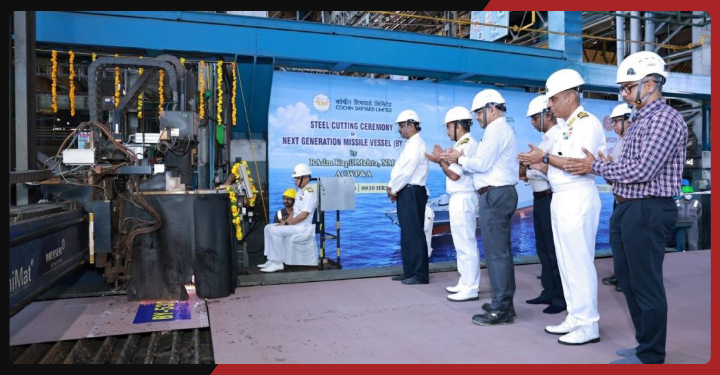
Cochin Shipyard Limited has laid the keel of the first Next Generation Missile Vessel being constructed for the Indian Navy, moving one of India’s upcoming naval shipbuilding programmes into a new phase. The ceremony took place in Kochi on September 18, 2026, with Vice Admiral Sanjay Sadhu, Controller of Warship Production and Acquisition, serving as chief guest.
The Indian Navy has ordered six NGMVs from CSL under a contract concluded in March 2023. The programme is designed to provide the Navy with high-speed vessels equipped with advanced weapons and sensors. The Ministry of Defence has described the ships as part of efforts to build a future-ready and combat-ready naval force.
A keel is a fundamental structural component of a ship and its laying represents a formal milestone in the vessel’s construction. In this case, the event follows the steel-cutting ceremony for the first NGMV held at CSL in December 2024. The first steel plate for Ship No. BY-531 was cut during that ceremony.
The transition from steel cutting to keel laying reflects the physical progress of the vessel’s construction. At the same time, the second NGMV has already entered an initial stage of construction. Steel cutting for the second ship was conducted at CSL on September 17, 2026, according to the Ministry of Defence.
The six vessels are expected to be high-speed platforms with a range of sophisticated weapons and sensors. Official information released during the earlier construction milestone identified surface-to-surface missile systems, anti-missile defence systems, air-surveillance radars and fire-control radars among the planned systems.
Such equipment is intended to allow the vessels to perform a variety of maritime missions. The platforms are envisaged for offensive operations against enemy surface vessels and land targets, while also supporting anti-surface warfare and local naval defence missions. They are also expected to contribute to the protection of offshore development areas.
The vessels’ high-speed characteristics are another important part of their planned role. The Times of India reported that the ships are designed to reach speeds of up to 33 knots and accommodate a crew of around 80 personnel. These details provide an indication of the operational concept behind the vessels, which combines speed with significant weapon and sensor capabilities.
The programme is also notable from an industrial perspective. CSL’s construction of the NGMVs represents a move into a more weapon-intensive segment of naval shipbuilding. The shipyard is therefore not simply delivering another class of vessels but expanding its experience in constructing advanced combat platforms.
The financial scale of the programme is substantial. CSL’s own December 2024 communication said the contract for six vessels was signed on March 30, 2023, with an order value of approximately ₹9,804 crore.
The programme has also been linked to India’s defence-indigenisation strategy. The Ministry of Defence has stated that major role-defining equipment for the NGMVs is being indigenously developed and manufactured. The government has placed the project within the broader framework of Aatmanirbhar Bharat, Make in India and Make for the World.
For the Navy, the programme is part of a broader effort to modernise its fleet and maintain capabilities in the Indian Ocean Region. Modern maritime security requires platforms capable of operating in environments where surveillance, speed, missiles and defensive systems play an increasingly important role.
The keel laying at Kochi therefore represents more than a ceremonial occasion. It marks a tangible stage in the development of a new naval platform and demonstrates progress in the six-ship construction programme.
As construction continues, further milestones will determine the pace at which the first vessel moves towards launch, testing and eventual induction. The NGMV programme will also provide CSL with additional experience in building sophisticated combat vessels for India’s naval fleet.