


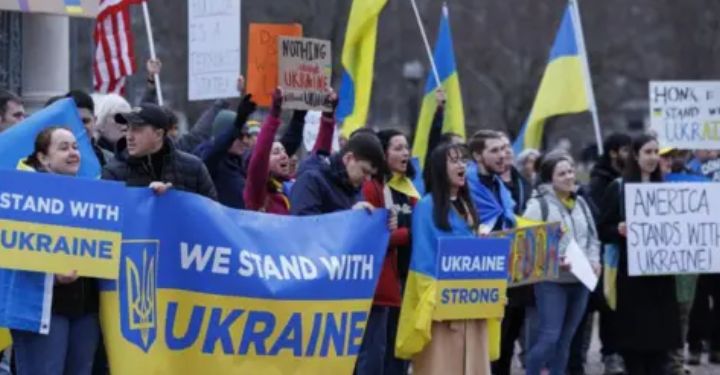
The United States has witnessed a surge in nationwide protests following controversial comments made by former President Donald Trump about Ukrainian President Volodymyr Zelensky. As tensions between Trump and Zelensky intensify, protesters have taken to the streets in cities across the country, calling for a firm U.S. stance in support of Ukraine and its battle against Russian aggression.
Trump’s recent remarks, in which he criticized Zelensky’s leadership and the level of U.S. involvement in the Ukrainian conflict, have sparked widespread outrage among Americans who see Ukraine as a symbol of resistance to authoritarianism. Protesters argue that Trump’s rhetoric undermines the efforts of the Ukrainian people and jeopardizes the security of democratic nations worldwide.
The demonstrations are not limited to a particular political group or region; rather, they reflect a broader consensus among Americans who view the situation in Ukraine as a crucial test of global resolve. Many citizens are calling for the U.S. to increase its support for Ukraine, whether through military aid, economic assistance, or diplomatic pressure on Russia.
Rising Protests
From the bustling streets of New York to the sun-soaked boulevards of Los Angeles, pro-Ukraine protests have spread rapidly, with participants marching, chanting, and demanding stronger U.S. support for Ukraine. In Washington D.C., protesters gathered in front of the White House, holding signs that read, “Stand with Ukraine” and “End Russian Aggression.”
“We cannot allow Ukraine to stand alone in this fight,” one protester stated in D.C. “The U.S. must do everything in its power to help Ukraine defeat Russia, and we need leadership that understands the importance of this fight.”
Trump’s Controversial Remarks
The protests came in response to a public spat between Trump and Zelensky, in which Trump disparaged Zelensky’s leadership and criticized the level of U.S. assistance to Ukraine. Trump’s comments were met with swift backlash, as many perceived them as undermining the U.S. commitment to a country that has been fighting for its sovereignty and democratic values since Russia’s invasion began.
While Trump continues to advocate for a more isolationist foreign policy, the protests reflect the strong sentiment among Americans that Ukraine’s struggle is not only important for Ukraine but for the larger fight against authoritarianism and for the preservation of democratic principles.
Politicians React
Political leaders in the U.S. have been quick to respond to the protests. Democratic lawmakers have used the demonstrations as a rallying cry to reinforce their commitment to supporting Ukraine, while Republican figures have been forced to navigate a complex political terrain. Some have echoed Trump’s skepticism about U.S. intervention, while others have called for continued support for Ukraine in the face of Russian aggression.
The protests have sparked renewed debate in Congress about the future of U.S. foreign policy and the role the country should play in supporting Ukraine’s defense.
Global Implications
The protests in the U.S. serve as a reminder that the war in Ukraine is not just a regional conflict—it is a defining moment in the global struggle between democracy and authoritarianism. With many countries, including the U.S., deeply involved in the conflict, the outcome of the war will have lasting implications for the international order.
The growing movement of pro-Ukraine protests signals that American citizens are paying close attention to the ongoing conflict and are demanding that their government stand firmly on the side of Ukraine. Whether the protests will lead to a shift in U.S. policy remains uncertain, but for now, the streets of America remain a battleground for Ukraine’s future.