


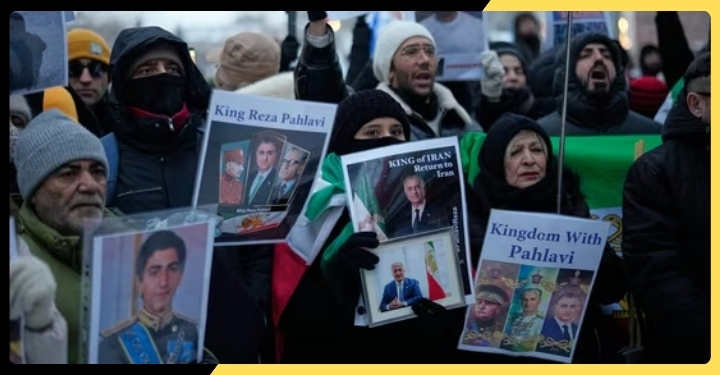
Iran’s exiled crown prince, Reza Pahlavi, has issued one of his strongest calls yet for coordinated nationwide civil resistance, urging Iranians to “bring the system to its knees” through sustained nonviolent disruption. The message, delivered through social media and interviews with Persian-language outlets abroad, reflects a shift from symbolic opposition toward a strategy aimed at exhausting the Islamic Republic’s governing capacity from within. Alongside the call, Pahlavi offered what many supporters interpreted as a subtle hint of a future return to Iran—one contingent on the collapse or withdrawal of the current ruling establishment.
Pahlavi, the son of Iran’s last monarch, has lived in exile since the 1979 Islamic Revolution. For decades, his role in Iranian politics remained largely ceremonial, with critics dismissing him as disconnected from realities on the ground. However, in the wake of recurring nationwide protests, economic hardship, and deepening public anger toward clerical rule, his voice has gained renewed traction among segments of the diaspora and within Iran itself.
The latest appeal does not call for armed revolt. Instead, it emphasizes mass participation in strikes, work slowdowns, boycotts, and refusal to cooperate with state institutions. According to Pahlavi, the Islamic Republic’s greatest vulnerability lies not in military confrontation but in its dependence on everyday compliance—from oil workers and truck drivers to teachers, shopkeepers, and civil servants.
“The regime survives because people are forced to keep it running,” he said in one recent statement. “When that cooperation ends, no amount of repression can save it.”
This approach echoes tactics used in other authoritarian contexts, where sustained civil resistance gradually weakened the state’s ability to function. Pahlavi’s framing positions ordinary Iranians as the primary agents of change, rather than foreign governments or exiled political elites. It also reflects a conscious effort to distance himself from perceptions of external interference—an accusation Tehran routinely uses to discredit opposition movements.
The timing of the call is significant. Iran continues to face severe economic pressure, exacerbated by sanctions, mismanagement, inflation, and currency depreciation. Power outages, water shortages, and delayed wages have fueled localized protests, even as security forces maintain tight control over large-scale demonstrations. Pahlavi’s message seeks to unify these scattered grievances into a coherent national strategy.
Equally notable was his suggestion that exile is not permanent. While stopping short of announcing plans to return, Pahlavi stated that he would come back “the moment conditions allow the people to decide their future freely.” For supporters, the comment signaled readiness to assume a more direct role in a post–Islamic Republic transition. For critics, it raised concerns about the reemergence of monarchical ambitions under the guise of democratic reform.
Pahlavi has repeatedly said he does not seek to restore the monarchy unless Iranians choose it through a referendum. He portrays himself as a facilitator of a national transition, advocating for a secular, democratic system that guarantees individual freedoms, gender equality, and separation of religion and state. Whether this message resonates broadly inside Iran remains difficult to measure, given censorship and the risks associated with public support for opposition figures.
Inside the country, reactions are mixed. Some activists welcome the focus on organized, nonviolent pressure, arguing that sporadic street protests alone are insufficient. Others remain skeptical of leadership from abroad, insisting that change must emerge organically from within Iran’s social movements rather than from a single figurehead.
The Iranian government, for its part, has dismissed Pahlavi as irrelevant, routinely branding him a foreign-backed agitator. State media has downplayed his statements, while security agencies continue to crack down on labor strikes and digital activism. Yet the persistence of economic unrest suggests that the underlying conditions he highlights remain unresolved.
Analysts note that the success of any nationwide civil resistance campaign depends on coordination, trust, and endurance—qualities that are difficult to sustain under intense surveillance and repression. Still, the call marks a notable escalation in tone, signaling that exiled opposition figures believe Iran may be entering a prolonged period of internal strain.
Whether Pahlavi’s strategy can translate into tangible change remains uncertain. What is clear is that the conversation about Iran’s future is no longer confined to ideological debates; it is increasingly focused on practical mechanisms for paralyzing a system many citizens view as unresponsive and illegitimate. In that sense, his message reflects a broader shift in opposition thinking—from protest as expression to protest as pressure.