


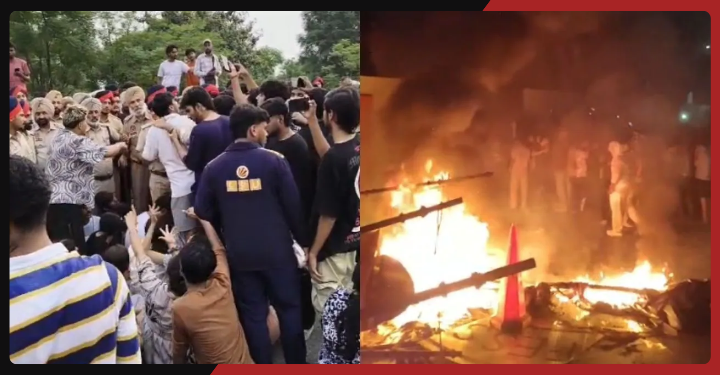
An unverified social-media claim about the alleged sexual assault of a female student triggered a dramatic overnight protest at Lovely Professional University in Phagwara, Punjab, on September 27. The demonstration escalated into vandalism, reports of fire on campus and a highway blockade, prompting the deployment of a heavy police presence.
The controversy began after messages circulated among students alleging that a woman student had been raped on the university campus. Different versions of the claim reportedly circulated online, including allegations involving a construction worker or outsider. Some posts also connected the alleged assault with the student’s supposed death by suicide. Authorities have not confirmed those additional claims.
Students gathered near the girls’ hostel at approximately 2 a.m., according to reports. What initially appeared to be a protest over concerns about student safety soon became disorderly. Window panes were damaged, flower pots were thrown and university property was vandalised.
The incident subsequently spread toward the university entrance. Students moved outside the campus and blocked a major highway connecting Phagwara and Jalandhar. The road disruption affected traffic and required police intervention.
The police response began after officials received information about the gathering. Kapurthala SSP Gaurav Toora said authorities reached the campus and discovered that rumours circulating about an alleged crime had contributed to the gathering. He said officers engaged with students and attempted to understand their concerns.
Initial police comments stressed that the alleged rape had not been confirmed. The absence of an immediate verified account did not, however, prevent the rumour from spreading among students. This created a difficult situation for authorities, who had to respond to both a potentially serious allegation and an increasingly volatile protest.
Later reporting provided additional developments. Police were reported to have received a student’s statement and registered a case, with DIG Jalandhar Range Naveen Singla saying investigators would examine forensic evidence, CCTV footage and phone records. This means the status of the matter evolved during the reporting period and remained subject to investigation.
The distinction between a rumour and an allegation under investigation is significant. A social-media post can spread a claim within minutes, but determining whether a crime occurred requires statements, evidence and an established investigative process.
University authorities issued appeals for calm. Students were reportedly advised to remain inside their hostels or residences and avoid provocative or disruptive activities. The administration said information circulating online was misleading and urged students not to participate in unrest.
The protests nevertheless reflected concerns that extended beyond the specific allegation. Police officials said students also raised grievances about university administration and complained that some issues had not been properly addressed.
For many universities, incidents involving allegations of sexual violence create immediate pressure on administrators to communicate clearly. Students want to know whether they are safe, whether authorities are investigating and whether protective measures are in place. Delays or conflicting information can increase anxiety, particularly when social media is already circulating competing versions of events.
In the LPU case, the speed at which the rumour spread contributed to a rapidly changing situation. The protest began during the night, when fewer administrative and public communication channels may be available. By the time police arrived, a significant gathering had already formed.
The highway blockade created another layer of concern. Roads connecting major cities carry large numbers of vehicles, and a sudden obstruction can affect commuters, emergency services and commercial traffic. Authorities therefore had to restore movement while attempting to avoid further confrontation.
Police also began assessing damage to university property. If individuals are identified as having participated in vandalism, arson or unlawful obstruction, they could face legal proceedings under applicable laws.
The incident has therefore developed along two separate tracks: the investigation into the alleged crime and the investigation into the unrest itself. Establishing one does not automatically establish the other.
For students, the key issue remains safety and access to accurate information. For authorities, the priority is evidence-based investigation and maintenance of public order.
The events at LPU serve as a reminder that serious allegations must be handled carefully. Claims involving sexual assault deserve immediate attention, but they also require responsible verification. Unverified claims can cause fear, damage reputations and provoke violence, while dismissing genuine complaints can undermine trust.
The coming stages of the police investigation will determine what evidence exists and whether criminal charges relating to the alleged assault are supported. At the same time, authorities will examine the vandalism and highway blockade that occurred during the protest.
Until those processes are completed, the public picture remains incomplete.