


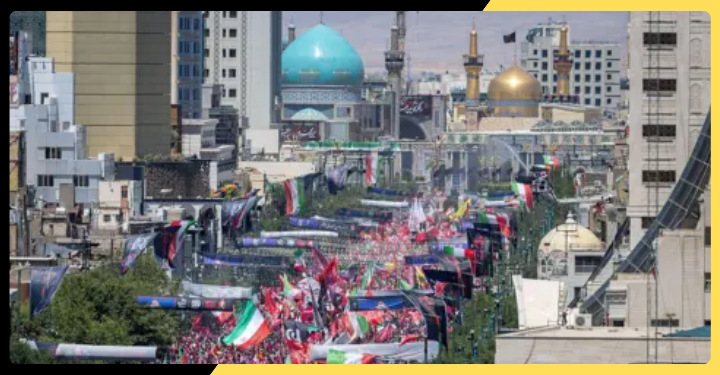
Mashhad, Iran: Iran witnessed an emotional and historic day as hundreds of thousands of mourners gathered in the northeastern city of Mashhad to bid farewell to the country’s late Supreme Leader, Ayatollah Ali Khamenei. The burial ceremony, held at the sacred Imam Reza Shrine, marked the conclusion of several days of nationwide mourning and funeral processions that drew millions of participants across different cities.
From the early hours of the morning, streets leading to the shrine were packed with mourners carrying Iranian flags, black banners, and portraits of the late leader. Many people traveled long distances from provinces across Iran to attend the final ceremony, viewing it as both a religious obligation and a moment of national importance.
The funeral procession moved slowly through Mashhad’s main avenues as religious chants filled the air. Volunteers distributed drinking water, food, and medical assistance to visitors, while security personnel worked to manage the enormous crowds gathering around the shrine complex. Helicopters monitored the area from above as emergency services remained on standby throughout the day.
Officials described the funeral as one of the largest public gatherings in Iran in recent decades. State television provided continuous live coverage, showing mourners offering prayers and expressing their grief. Religious scholars led special ceremonies before the coffin entered the Imam Reza Shrine for the final burial.
The Imam Reza Shrine holds immense religious significance for Shiite Muslims and was chosen as the burial site because of its spiritual importance as well as Khamenei’s birthplace in Mashhad. Many mourners said the location reflected the deep connection between the late leader and one of Islam’s holiest sites.
Throughout the ceremony, senior Iranian officials, military commanders, religious leaders, and representatives from allied countries attended memorial events. President Masoud Pezeshkian joined funeral prayers and praised Khamenei’s leadership, describing him as a figure who guided Iran through decades of political and regional challenges.
Religious speakers highlighted Khamenei’s role in shaping Iran’s domestic policies, strengthening its military capabilities, and supporting regional allies. They urged citizens to remain united during the transition to new leadership while emphasizing the importance of protecting the country’s independence.
Many participants carried signs expressing support for the Islamic Republic and condemning Israel and the United States, which Iranian authorities have blamed for the attack that led to Khamenei’s death. Emotional speeches and chants echoed throughout the funeral route, reflecting both grief and determination among many attendees.
Businesses across Mashhad remained closed during much of the day as residents joined the mourning ceremonies. Schools, government offices, and many commercial centers also suspended normal operations to allow employees and students to participate in the national tribute.
Local charities and volunteer organizations established service stations throughout the city, offering free meals, water, transportation assistance, and first aid to the large number of visitors. Hotels and guesthouses reached full capacity as pilgrims continued arriving from different regions.
International observers closely monitored the funeral, viewing it as an important moment for Iran’s political future. Analysts believe the peaceful organization of the ceremony demonstrated the government’s efforts to project stability during a sensitive period following the leadership transition.
Despite the massive turnout, authorities reported that the ceremonies remained largely orderly due to extensive planning and the cooperation of volunteers and security forces. Traffic restrictions remained in place throughout the city until late evening as mourners gradually dispersed after the burial.
As sunset approached, final prayers were offered inside the Imam Reza Shrine, bringing the funeral ceremonies to a close. For many Iranians, the day represented the end of an era that shaped the nation’s political and religious identity for decades.
With the burial complete, attention is now shifting toward Iran’s future leadership, economic challenges, and regional diplomacy. While questions remain about the country’s next chapter, the funeral in Mashhad will be remembered as one of the largest and most significant public ceremonies in modern Iranian history.