


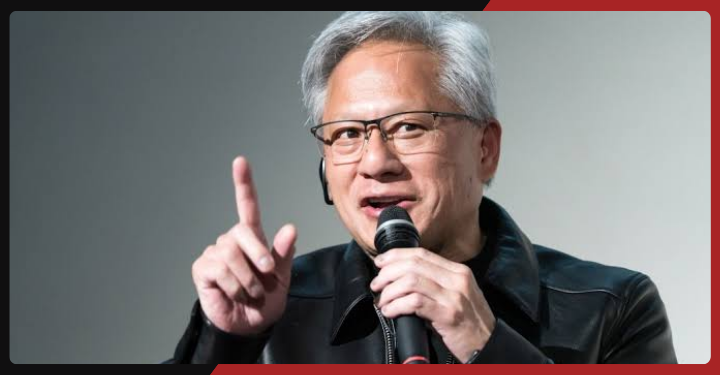
A surprise phone call from President Donald Trump interrupted Nvidia CEO Jensen Huang during a technology conference in Los Angeles, creating an unusual live discussion about one of the biggest questions facing the technology industry: how concerned should the world be about artificial intelligence?
Huang was speaking at the All-In Summit when Trump called him. The Nvidia chief answered the phone and put the president on speaker, allowing the audience to listen to their conversation. The unexpected exchange quickly became one of the most talked-about moments of the conference.
The subject of the conversation was not business alone. Trump wanted to address growing concerns about artificial intelligence and the possibility that increasingly advanced systems could become dangerous. Several prominent technology leaders and researchers have recently called for more caution, arguing that AI development should not continue without stronger safety measures.
Trump took a very different position. He rejected the idea that AI represented an existential threat to humanity and described fears about AI taking over the world as a hoax. He also told the audience that robots were not going to take control.
The president’s remarks came at a time when the technology industry is deeply divided over AI development. On one side are executives and researchers who believe that rapid progress is necessary to maintain innovation and economic competitiveness. On the other are experts who argue that companies need to slow down when necessary and introduce stronger independent safeguards.
Huang has generally been associated with the pro-development side of the debate. Nvidia’s business is closely connected to the growth of artificial intelligence because its processors are widely used to train and operate advanced AI systems. As demand for AI computing has exploded, Nvidia has become one of the most important companies in the global technology industry.
During the conversation, Trump also connected AI development with competition between the United States and China. He argued that excessive restrictions could weaken America’s position and allow China to gain an advantage in one of the most strategically important technologies of the century.
This argument has become increasingly important in Washington. Artificial intelligence is no longer viewed simply as a consumer technology. It is connected to military capabilities, cybersecurity, economic productivity, scientific research and national competitiveness.
Trump has also emphasized the economic importance of AI infrastructure, particularly data centers. These facilities require enormous amounts of computing power and electricity, but they also create demand for construction, semiconductor manufacturing, networking equipment and other industries.
Huang’s reaction during the call suggested that he was comfortable allowing Trump’s message to reach the audience. The Nvidia CEO has repeatedly argued that fears surrounding AI should not become an excuse for stopping technological progress.
However, the discussion does not mean that safety concerns have disappeared. Even companies strongly supporting AI development have invested heavily in safety research. The central disagreement is increasingly about how safety should be achieved without preventing useful innovation.
The surprise phone call therefore became a symbolic moment in the wider AI debate. Instead of discussing artificial intelligence in technical terms alone, Huang and Trump presented two major themes shaping the industry: technological ambition and political competition.
The incident also highlighted Huang’s growing influence. Few technology executives can receive a call from the president in the middle of a public appearance and turn it into a discussion heard by a major conference audience.
For Nvidia, the moment reinforced its position as a central player in America’s AI strategy. For Trump, it provided a public platform to challenge growing warnings about AI.
As the technology continues to advance, the question will remain whether the world can maintain rapid AI innovation while developing enough safeguards to prevent serious harm. Huang’s conversation with Trump showed that the debate is becoming increasingly public, political and consequential.