


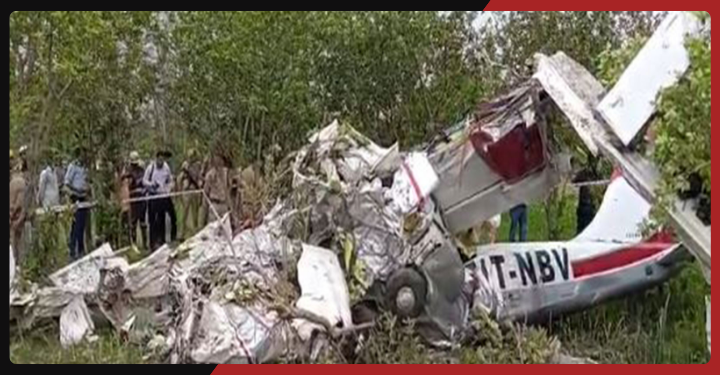
Two pilots were killed after a training aircraft crashed into a field near the Ganga Barrage in Kanpur on Thursday, August 27, 2026. The aircraft was being operated by Garg Aviation and was carrying an instructor and a trainee pilot when it crashed. Both occupants died in the accident.
The aircraft involved was a Tecnam P2006T, a twin-engine, four-seat aircraft commonly used for flight training. Its registration was VT-NBV. The aircraft came down near the Ganga Barrage, close to Nathupurwa village, according to reports from the area.
The crash was reported during the daytime, and police and emergency teams quickly moved toward the location. The aircraft suffered extensive damage in the impact. Photographs and video footage from the scene showed wreckage spread across an open agricultural field.
Local residents were among the first people to reach the vicinity after hearing the crash or noticing the aircraft on the ground. Police later secured the area and restricted access so that rescue workers and investigators could operate safely.
The accident is particularly significant because both people aboard were involved in pilot training. One was an instructor responsible for supervising the flight, while the other was a trainee learning and developing flying skills.
Training flights are conducted under specific safety procedures. An instructor normally monitors the trainee’s performance and can take control of the aircraft if necessary. Despite these safeguards, aviation emergencies can develop rapidly, leaving pilots with very limited time to respond.
At this stage, authorities have not confirmed what caused the Kanpur aircraft to crash. The investigation will be required to determine whether the aircraft suffered a technical problem, whether there was a problem during a training manoeuvre or whether some other factor contributed to the accident.
The DGCA is expected to examine the aircraft and operational records as part of its investigation. Such investigations generally seek to reconstruct the final stages of a flight by studying the aircraft wreckage, maintenance documents, flight information and other available evidence.
Aviation safety experts are likely to pay particular attention to the aircraft’s condition and maintenance history. The Tecnam P2006T involved in Thursday’s accident had reportedly been involved in another incident in June at Kanpur’s Chakeri Airport. That earlier incident involved a trainee pilot who was injured by a running propeller after landing. DGCA had ordered an inquiry into that incident.
There is currently no official indication that the June incident contributed to the August crash. The two events should therefore be treated separately unless investigators establish a link.
The Kanpur accident also highlights the importance of safety within India’s expanding pilot-training sector. As demand for aviation professionals increases, flying training organisations have an important responsibility to maintain aircraft, train pilots and operate flights according to regulatory standards.
For trainee pilots, instructor supervision is a central part of the learning process. Instructors are expected to teach students how to handle normal operations as well as abnormal and emergency situations. Their role therefore carries significant responsibility.
The loss of both pilots is a devastating outcome for their families, colleagues and the aviation community. While details about their individual backgrounds have not been fully established in authoritative early reports, officials have confirmed that both were aboard the aircraft at the time of the crash.
The accident remains a developing story. Authorities are continuing to investigate the circumstances and will have to establish a factual sequence of events before determining responsibility or recommending safety measures.
Until then, speculation about the cause should be avoided. Mechanical failure, pilot error, weather, operational circumstances or other possibilities should not be treated as confirmed without evidence.
The Kanpur crash is a reminder that aviation safety depends on multiple layers of protection. Investigators will now examine each of those layers to determine what went wrong and whether changes are needed to reduce the possibility of another tragedy during a training flight.