


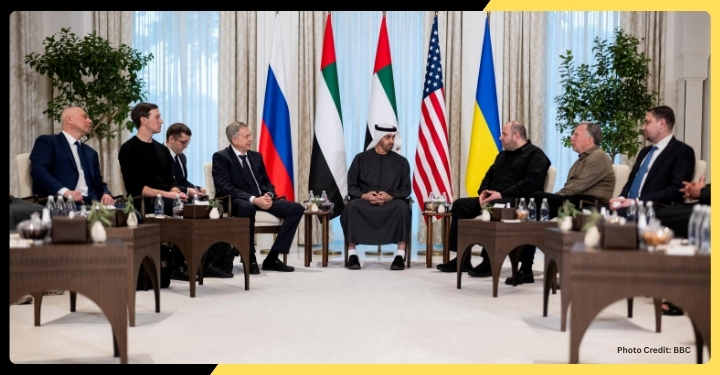
A renewed round of peace negotiations involving Ukraine, Russia, and the United States began on February 4 and 5 in Abu Dhabi, marking a highly anticipated follow‑up to earlier talks held in the United Arab Emirates as part of an ongoing effort to end the nearly four‑year‑long war. The two‑day trilateral discussions have returned to the UAE capital as diplomatic efforts to find a political resolution continue, even as violence on the ground and deep disagreements over key issues cast doubt on prospects for a breakthrough.
Context: War and Peace Negotiations
The war between Russia and Ukraine began with Moscow’s full‑scale invasion in February 2022. Over the course of the conflict, tens of thousands of people have been killed, millions displaced, and vast swathes of Ukraine’s eastern and southern regions devastated. Efforts to negotiate a ceasefire or broader peace deal have repeatedly floundered, with both sides entrenched in their positions on fundamental issues such as territorial control, security guarantees, and the future status of occupied regions.
In January 2026, the first round of U.S.‑brokered trilateral peace talks took place in Abu Dhabi. While officials described aspects of those discussions as constructive, they stopped short of producing concrete agreements on the war’s core issues, and positions remained sharply divided. The second round, scheduled for February 4–5, came after a brief postponement due to logistical coordination among the delegations.
At the Opening: Delegations Arrive Amid Tensions
Representatives from Ukraine and Russia arrived in Abu Dhabi on Wednesday morning to reconvene the talks, with the U.S. delegation’s arrival expected shortly thereafter. Ukraine’s negotiating team is led by Rustem Umerov, head of Ukraine’s National Security and Defence Council, while Russia’s delegation includes senior military officials. The United States, serving as mediator, is represented by special envoys tasked with facilitating peace efforts.
The talks are taking place against a backdrop of heightened tension. Just days before the meeting, Russia launched a large‑scale barrage of missiles and drones targeting Ukraine’s energy infrastructure in one of the most intense strikes of the war this winter. The assault knocked out power and heating for thousands of civilians enduring frigid temperatures, leading Ukrainian President Volodymyr Zelenskyy to accuse Moscow of violating a limited ceasefire agreement and to question Russia’s commitment to diplomacy.
In Kyiv, public sentiment remains largely skeptical that negotiations will yield immediate results, particularly as Russia continues offensive operations on multiple fronts. Many Ukrainians are hoping nevertheless that the talks might lead to some respite from attacks on critical infrastructure, even if a comprehensive peace deal remains elusive.
Core Disputes: Territory and Security Guarantees
At the heart of the negotiations are three deeply contentious issues: the future status of territory currently occupied by Russia, security guarantees for Ukraine, and the mechanisms for ensuring any ceasefire holds.
- Territorial Control:
Russia continues to insist on territorial concessions, demanding that Ukraine withdraw its troops from significant portions of the Donbas region and recognize areas Moscow has annexed. These included not only Donetsk but also parts of Luhansk, Kherson, and Zaporizhzhia, territories that Russia seized and unilaterally declared part of its sovereign territory. Ukraine categorically rejects any one‑sided withdrawal, insisting that control of its land must be determined through negotiation without forced concessions. - Security Guarantees:
Kyiv is seeking binding security guarantees from Western partners, including the United States and European nations, to ensure that Ukraine cannot be attacked again in the future. Moscow, however, opposes the deployment of foreign troops on Ukrainian soil, arguing that it would escalate the conflict and entrench Western military influence near its borders. - Ceasefire and Compliance:
Russia has repeatedly used pauses in fighting to regroup or intensify operations elsewhere, leading Ukrainian leaders to view proposed ceasefire agreements with deep suspicion. The recent winter strikes that preceded the Abu Dhabi talks have hardened Kyiv’s stance, with Zelenskyy indicating that Ukraine’s negotiating approach would be adjusted in light of Russia’s actions.
The U.S. Role and International Dynamics
The United States continues to play a central mediating role in the talks, seeking to balance its support for Ukraine with pressure on Russia to engage constructively in diplomacy. U.S. envoys have described discussions as “productive and constructive” in some respects, but acknowledged that major obstacles remain. Washington also faces pressure from European and NATO partners to maintain military support for Ukraine while pursuing diplomatic channels.
The choice of Abu Dhabi as a neutral venue reflects the UAE’s role as an international intermediary. The Emirati government has maintained diplomatic relations with both Russia and Ukraine and has been involved in humanitarian efforts, including facilitating prisoner exchanges. UAE officials view the capital as a suitable setting for sustained dialogue, even amid criticism of hosting belligerents.
What’s Next: Outlook and Risks
As the two‑day negotiations unfold, all sides face significant hurdles. Russia has so far shown no willingness to shift its demands on territorial issues, while Ukraine remains resolutely opposed to any deal that would compromise its sovereignty. International observers caution that without substantive concessions from Moscow or a breakthrough on security arrangements, the talks may conclude without tangible progress.
Analysts also warn that continued military pressure—especially attacks on civilian infrastructure—could further undermine trust and complicate diplomatic efforts. Even if the Abu Dhabi talks do not yield a full peace agreement, they may help clarify the contours of future negotiations or identify areas where smaller steps toward de‑escalation are possible.