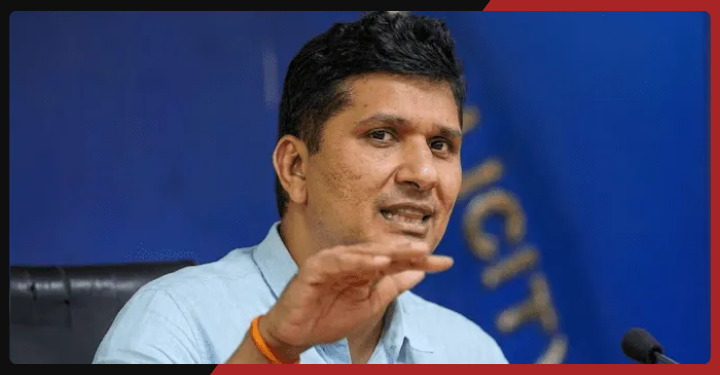
A dispute that began with a ₹97-crore recovery order soon developed into a much larger political confrontation between the Aam Aadmi Party and the Bharatiya Janata Party. AAP leader Saurabh Bharadwaj strongly criticised the action and countered that BJP-ruled states had themselves spent around ₹22,000 crore on advertisements.
The controversy centred on government advertising and the rules governing the use of public money for publicity. Delhi Lieutenant Governor V K Saxena had directed the Chief Secretary to recover ₹97 crore from the AAP over advertisements that authorities said had violated guidelines by allegedly functioning as political publicity.
The AAP rejected the charge and questioned the legal basis of the recovery order. Bharadwaj argued that the Delhi government was being targeted even though governments across the country regularly advertise their schemes in newspapers, television channels and other media platforms that operate beyond their state boundaries.
The AAP leader’s response was to broaden the debate. He claimed that BJP-ruled states had spent approximately ₹22,000 crore on advertisements appearing in other states and asked why the same scrutiny was not being applied to those expenditures.
His remarks transformed the dispute from a question about one government’s advertising expenses into a national political argument over government publicity. The BJP and AAP were already engaged in an intense political contest, and the advertising controversy provided another issue on which both sides could attack each other.
The original recovery demand was connected to an earlier examination of government advertisements issued by the Delhi administration. A committee appointed by the Union government had concluded in 2016 that the Delhi government had misused taxpayers’ money through certain advertisements and had recommended recovery of funds.
The Lieutenant Governor later relied on the matter while ordering action against the Delhi government. AAP leaders, however, argued that the issue had been revived for political reasons.
Bharadwaj questioned the logic behind treating Delhi government advertisements as improper merely because they appeared outside Delhi. Government programmes often require publicity because citizens may travel, work or consume media across state borders. Newspapers distributed in Delhi, for example, can carry advertisements from governments in Uttar Pradesh, Haryana, Madhya Pradesh and other states.
The AAP therefore argued that geographical circulation alone should not determine whether an advertisement is legitimate.
The political exchange also raised an important question about government spending. Advertising budgets are public expenditure, meaning that governments are expected to justify them through public interest objectives. Publicity about health campaigns, welfare schemes, environmental initiatives and emergency information can serve a genuine public purpose. However, advertising can become controversial when government campaigns prominently feature political personalities or messages associated with ruling parties.
The Supreme Court’s guidelines on government advertising were intended to address this concern. They seek to prevent public money from being used primarily for political promotion.
Bharadwaj’s ₹22,000-crore allegation therefore became part of a larger debate about whether those principles were being applied consistently. He argued that the BJP should answer questions about advertising expenditure in states it governed.
The figure itself needs to be treated carefully. Contemporary reports describe it as Bharadwaj’s claim. It should not be presented as an independently verified ₹22,000-crore scam. The available sources reviewed do not establish a rice-related scam involving Delhi government or prove that ₹22,000 crore was illegally diverted.
The episode nevertheless demonstrated the political power of large financial figures. Once a figure running into thousands of crores enters a political debate, it can dominate public discussion even when the underlying calculation is disputed.
For the AAP, the controversy provided an opportunity to challenge the BJP’s criticism and portray the recovery order as selective. For the BJP and the Lieutenant Governor’s office, the matter was about accountability for the use of public funds.
The dispute therefore had two dimensions: a legal-administrative question concerning government advertisements and a political battle over accountability.
Ultimately, determining whether any expenditure violated the rules requires examination of individual advertisements, their content, approving authorities, expenditure records and applicable guidelines. Political accusations alone cannot establish a scam.
The controversy remains an example of how disputes over public expenditure can quickly become larger battles over political credibility, transparency and the limits of government publicity.
Journalist Details