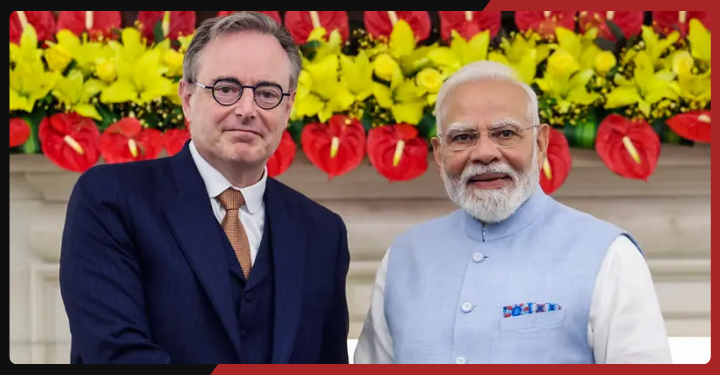
Belgian Prime Minister Bart De Wever’s candid admission that Europe failed to listen to India’s earlier warnings has become an important moment in the growing relationship between India and European nations.
During discussions in India, De Wever openly acknowledged that Europe had been slow to understand the risks associated with excessive economic dependence. He said India had identified the problem earlier and had warned Europe, but those warnings were not given enough attention.
The statement is particularly significant because it reflects changing attitudes in Europe towards global trade and strategic partnerships.
For decades, globalisation encouraged countries to build highly interconnected economies. Nations imported goods from distant markets, industries moved production across borders, and companies created complex international supply chains.
This system brought major economic benefits. Consumers gained access to cheaper products, businesses entered new markets and countries became more economically connected.
However, recent global developments have exposed the weaknesses of excessive dependence.
The COVID-era supply disruptions, geopolitical conflicts and growing competition between major powers demonstrated how quickly global supply chains could become vulnerable. Countries that depended heavily on limited suppliers for critical products suddenly faced shortages and strategic risks.
Europe has increasingly recognised these concerns.
According to De Wever, India understood these dangers earlier. He specifically credited Prime Minister Narendra Modi with warning Europe about the consequences of allowing strategic dependencies to become too strong.
The Belgian Prime Minister’s message was clear: Europe did not listen then, but it is listening now.
This changing attitude could have major consequences for India-Europe relations.
India is increasingly being viewed as an important alternative manufacturing, technology and investment partner. Its large economy, expanding industrial capacity, skilled workforce and strategic position make it attractive to countries seeking to diversify their international partnerships.
Belgium, meanwhile, plays an important role in Europe because of its strong industrial base, logistics infrastructure and major ports.
The two countries have therefore identified several areas where cooperation can grow. These include defence, clean energy, critical minerals, semiconductors, technology and investment.
The broader India-Europe relationship is also becoming more important as governments attempt to build resilient supply chains.
De Wever argued that economic relationships should not become tools for political pressure. Countries, he suggested, need partnerships based on trust and mutual interests rather than relationships where dependency can be used against them.
His comments also highlighted India’s position in the emerging global order.
India has consistently attempted to maintain relationships with different power centres while protecting its strategic independence. Rather than becoming completely dependent on one bloc, India has pursued partnerships with countries across the world.
That approach is now attracting increasing international attention.
Europe’s delayed recognition of these risks could create new opportunities for cooperation with India. European companies looking to diversify production and supply chains may increasingly view India as an important destination.
For India, stronger engagement with Europe could bring investment, technology, industrial cooperation and greater access to international markets.
De Wever’s words therefore carry a larger diplomatic message.
The relationship between India and Europe is moving beyond traditional trade discussions. Economic security, strategic trust and technological cooperation are becoming central to the partnership.
The Belgian Prime Minister’s admission—“we didn’t listen”—may be remembered as a symbol of Europe’s changing perspective.
India issued its warning earlier.
Europe may have taken time to understand it.
But now, according to Belgium’s Prime Minister, Europe is finally listening.
Journalist Details