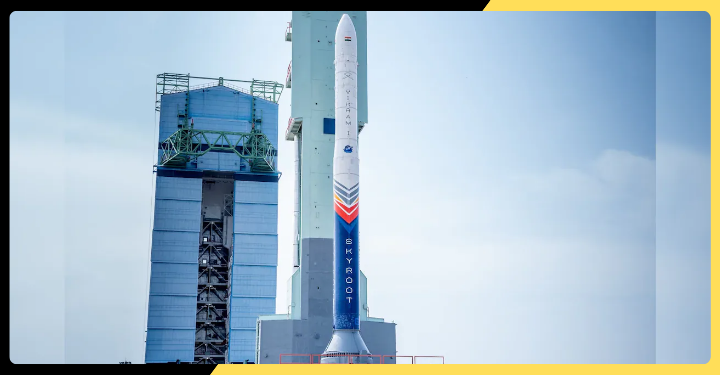
The successful launch of Vikram-1 has firmly established Skyroot Aerospace as one of India’s leading private space companies. By placing its rocket into orbit, the Hyderabad-based startup demonstrated that Indian private enterprises are capable of developing sophisticated launch vehicles that meet international standards. While the achievement has earned widespread recognition, it also marks the beginning of a far more demanding phase. In the commercial space industry, a successful launch is only the first step. The real challenge lies in transforming engineering excellence into a profitable, scalable, and sustainable business.
For most space startups, reaching orbit is considered the defining technical milestone. It validates years of research, testing, and investment while proving that the company’s technology works under real mission conditions. However, commercial customers and investors evaluate launch providers on much more than a single successful mission. They expect consistent reliability, competitive pricing, timely delivery, and the ability to support multiple launches every year.
Skyroot now finds itself at this critical crossroads. The company has demonstrated that it can build and launch an orbital rocket, but maintaining momentum requires establishing a dependable launch schedule. Satellite operators typically plan missions years in advance, and they need confidence that launch providers can meet deadlines without unexpected delays. Building such operational reliability is often more difficult than achieving the first successful launch itself.
Another challenge involves increasing launch frequency. Space companies cannot rely on occasional demonstration missions to generate meaningful revenue. Commercial success depends on launching rockets regularly while maintaining strict safety and quality standards. Every additional mission provides valuable operational experience, improves manufacturing processes, and strengthens customer confidence. For Skyroot, increasing the number of launches without compromising reliability will be one of its most important business objectives.
Cost management is equally critical. Developing rockets requires significant investments in research, infrastructure, manufacturing facilities, testing equipment, and highly skilled engineers. Even after achieving orbital capability, companies must continue investing in product improvements and production efficiency. Unless operating costs decline over time, maintaining profitability becomes increasingly difficult in a competitive global market.
The commercial launch industry has become more crowded than ever. Established companies across the United States, Europe, and Asia are competing aggressively for satellite launch contracts. Many have already completed dozens or even hundreds of successful missions, giving them extensive operational experience and well-established customer relationships. Some competitors also benefit from reusable rocket technology, allowing them to reduce launch costs and improve profit margins.
To compete effectively, Skyroot must identify areas where it can offer unique value. Dedicated small satellite launches remain one of the company’s strongest opportunities. Many satellite operators prefer dedicated launch vehicles because they provide greater control over launch timing and orbital placement compared with rideshare missions. By focusing on flexibility, responsiveness, and customized mission planning, Skyroot can carve out a competitive position despite facing larger international rivals.
Customer acquisition represents another major challenge. Every commercial launch contract involves months of technical discussions, regulatory approvals, mission planning, and financial negotiations. Winning contracts requires more than technical capability—it demands strong customer relationships, responsive service, transparent communication, and confidence in long-term reliability. Building this reputation takes time, especially in an industry where mission failures can have serious financial consequences.
Investor expectations are also evolving. During the early startup phase, investors often prioritize technological progress. Once a company reaches orbit, however, attention shifts toward revenue generation, profitability, and long-term business growth. Investors want to see signed commercial agreements, expanding order books, repeat customers, and clear plans for scaling operations. Skyroot will need to demonstrate that its technology can consistently generate commercial returns.
Government policy continues to provide important support for India’s private space sector. Regulatory reforms have encouraged greater private participation while creating opportunities for collaboration with national space institutions. Access to testing facilities, launch infrastructure, and technical expertise helps reduce barriers for emerging companies. Continued policy support could further strengthen India’s position as a global space technology hub.
Looking beyond launch services, Skyroot may also benefit from expanding into related space businesses. Satellite deployment, mission integration, orbital logistics, and advanced propulsion technologies represent potential areas for diversification. Offering a broader range of services could create additional revenue streams while strengthening customer relationships.
The global demand for satellite launches is expected to grow steadily over the next decade as industries increasingly depend on space-based technologies. Communications, Earth observation, navigation, climate monitoring, disaster management, agriculture, and defense all require expanding satellite constellations. This growing demand provides a favorable market environment for capable launch providers that can deliver reliable and cost-effective services.
Vikram-1’s successful mission has undoubtedly changed the trajectory of Skyroot Aerospace. It has demonstrated India’s growing capabilities in private space technology and attracted international attention. Yet history shows that the path from technological achievement to commercial leadership is rarely straightforward. Skyroot’s future will depend not only on building excellent rockets but also on delivering reliable services, winning customer trust, controlling costs, and expanding its business strategically. If the company successfully meets these challenges, Vikram-1 will be remembered not merely as a historic launch but as the foundation of one of India’s most influential private space enterprises.
Journalist Details