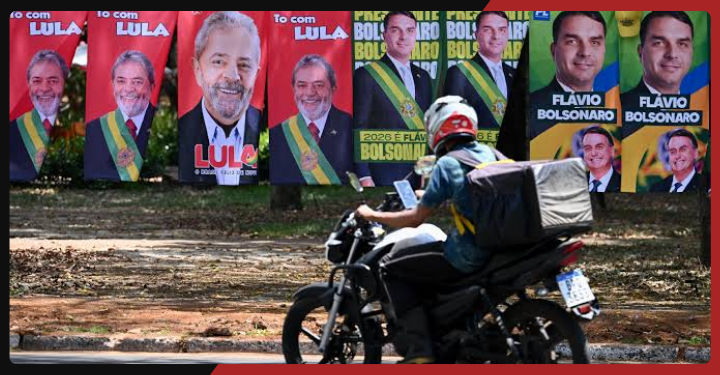
Brazil’s presidential election is moving toward a likely runoff after projections showed former President Jair Bolsonaro’s advantage narrowing during the vote count. What initially appeared to be a stronger lead became increasingly competitive as more ballots were included in the projections.
The development has transformed expectations surrounding the election and raised the possibility that Brazil will require a second round to choose its next president.
Brazil’s electoral system requires a candidate to secure the necessary majority for an outright victory. If no candidate reaches that threshold, the leading contenders advance to a runoff.
The narrowing gap between Bolsonaro and his main challenger has therefore become the central focus of the election night. Supporters of both campaigns are closely monitoring the vote count while waiting for the official electoral authority to confirm the final figures.
Bolsonaro entered the contest with a strong political base. His years as president established him as one of the most influential figures on Brazil’s political right. Even after leaving office, he retained significant support among conservative voters.
His supporters point to policies associated with his administration and argue that Brazil needs a government willing to take a tougher approach to crime, government spending and social issues.
Critics, however, have questioned Bolsonaro’s record and political approach. His presidency was marked by repeated clashes with political opponents, institutions and sections of the media. Those divisions continue to shape the political landscape.
The possibility of a runoff means both candidates will have to prepare for a new phase of campaigning. A second round is fundamentally different from the first because candidates must persuade voters who supported other contenders.
Smaller parties and candidates could therefore become important. Their supporters could determine which major candidate ultimately wins the presidency.
Negotiations and political alliances may begin almost immediately. Candidates could seek endorsements from defeated rivals and attempt to attract voters from across the ideological spectrum.
Economic concerns are likely to be central to the campaign. Brazil faces challenges involving inflation, public finances, employment, investment and economic growth. Voters are also concerned about public services and living costs.
Security remains another major issue. Brazil has long struggled with violent crime, and political debates over policing and public safety are deeply influential in many communities.
Environmental policy could also become important. Brazil contains much of the Amazon rainforest, making its policies significant not only domestically but internationally. Any change in government could affect Brazil’s approach to environmental protection, agriculture and climate negotiations.
Foreign policy is another area where the election could produce changes. Brazil maintains relationships with major powers and plays an important role in regional organizations. The president’s political orientation can influence the country’s diplomatic priorities.
For investors, uncertainty surrounding the election may remain a concern until the final result is known. Financial markets often respond to expectations about government spending, taxation, regulation and economic management.
The narrowing Bolsonaro lead shows how quickly election projections can change as votes from different regions are counted. Early results do not always provide a complete picture because voting patterns can vary considerably between states and regions.
For now, the election remains unsettled. The final outcome will depend on the official count and whether either candidate can achieve the required majority.
If projections continue to point toward a runoff, Brazil will face another campaign before the presidency is decided.
Journalist Details