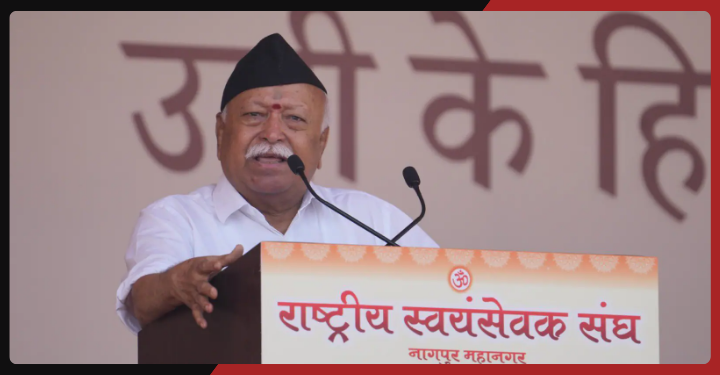
RSS chief Mohan Bhagwat’s latest Vijayadashami address placed India’s political debate within a wider international context, as he cited developments in France, Albania, Bangladesh and Nepal while warning against attempts to bring about regime change. Addressing the organisation’s annual gathering in Nagpur on October 20, 2026, Bhagwat questioned the belief that replacing a government necessarily leads to better conditions for citizens.
The countries mentioned in his speech have experienced different political circumstances, making comparisons between them complex. France has witnessed significant public demonstrations and political disputes, while Bangladesh and Nepal have undergone major political upheavals. Albania has also experienced political tensions and public opposition. Although these examples can illustrate the challenges governments face, their individual circumstances should not be treated as identical.
Bhagwat’s broader argument was that a change in political leadership cannot, by itself, guarantee solutions to deep-rooted problems. A country may replace its government while continuing to face economic pressures, social disagreements, institutional challenges or public dissatisfaction. In his view, political movements should therefore be judged by the outcomes they produce rather than by their ability to remove an existing administration.
This argument raises an important question about the expectations citizens place on political movements. Protests often emerge when people believe that ordinary channels of representation have failed to address their concerns. Demonstrators may seek accountability, reforms, leadership changes or the correction of specific policies. Their demands can be diverse, and the eventual outcome depends on the political system and circumstances involved.
The French example highlights the complicated relationship between street protests and formal political institutions. Public demonstrations can place pressure on governments and force political leaders to reconsider their decisions. Yet protests may also continue even after policy changes or political concessions, especially when the underlying causes of dissatisfaction remain unresolved.
Bangladesh and Nepal provide different contexts for examining political change. Political upheavals can reshape leadership and public expectations, but the transition that follows often creates its own challenges. Maintaining stability, rebuilding confidence in institutions and responding to citizens’ demands require sustained political and administrative work.
Albania’s inclusion in Bhagwat’s remarks similarly points to his concern about political tensions beyond India. However, the precise lessons that India should draw from another country depend on its constitutional arrangements, political history and the specific circumstances of the unrest.
Bhagwat argued that similar attempts to destabilise India were underway and suggested that outside interests could exploit internal disagreements. These were allegations made in his speech, rather than independently established findings about the motivations behind particular protests.
The distinction matters because international comparisons can help explain political risks, but they can also oversimplify complex situations. A protest demanding electoral transparency, for example, cannot automatically be equated with an effort to overthrow a government. Its purpose must be assessed through the organisers’ stated objectives, their conduct and the evidence available.
Bhagwat urged political movements to focus on solutions and avoid creating hostility within society. His comments underline the need for dialogue between citizens, political parties and institutions when disagreements become intense.
The wider lesson is that political change and institutional reform are not interchangeable. A leadership transition may open the door to reform, but lasting improvements depend on effective governance, public trust and the ability to address citizens’ concerns.
For India, the debate should therefore extend beyond whether regime change is desirable or possible. It should also examine how democratic institutions can respond to criticism, how public grievances can be addressed and how political disagreements can be resolved without violence or intimidation.
Bhagwat’s international comparisons have intensified discussion about political stability and democratic accountability. Their lasting value will depend on whether the debate encourages a closer examination of the causes of unrest and the practical measures needed to prevent social and institutional divisions from deepening.
Journalist Details