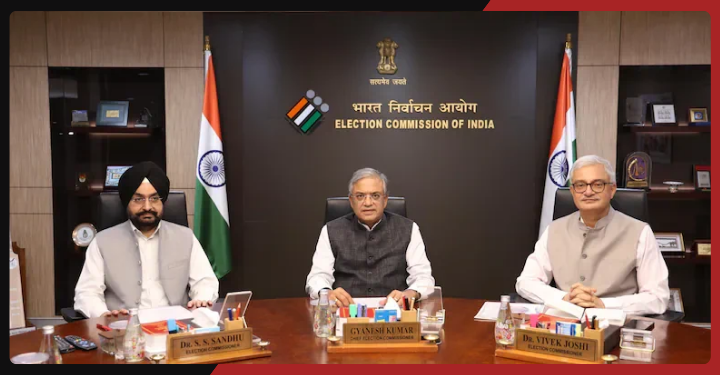
The Special Intensive Revision of electoral rolls has emerged as the central issue behind the latest controversy surrounding Chief Election Commissioner Gyanesh Kumar and the Election Commission of India.
The debate gained momentum after reports that Election Commissioners Sukhbir Singh Sandhu and Vivek Joshi had raised objections on multiple occasions concerning decisions associated with electoral-roll management. A detailed report published by The Indian Express said the two Commissioners had formally recorded objections at least 14 times over a period of 10 months.
Among the reported areas of concern were changes relating to voter registration, deletion and restoration of names, Form 6 and the functioning of the Election Commission’s electoral database.
Form 6 is particularly important because it is used for applications for inclusion of a person’s name in the electoral roll. Questions concerning its modification therefore have direct relevance to the voter-registration process.
The reports triggered a political debate over whether the Election Commission had been functioning collectively. Opposition parties have used the reports to question the Commission’s handling of the SIR exercise and have demanded greater accountability from the poll body.
The Election Commission, however, has presented a different interpretation.
In its clarification, the ECI said that differing views are a normal feature of deliberation within an institution. The Commission stated that members and officers are entitled to offer suggestions, observations and technical inputs during the decision-making process. It maintained that final decisions were taken unanimously by the full Commission.
This distinction is at the heart of the controversy.
A written objection during an internal discussion indicates that a member raised a concern. It does not, by itself, establish that the Commission ultimately adopted a decision without collective approval. The ECI has specifically argued that internal deliberations should not be confused with the final institutional position.
The issue has become more important because SIR directly affects electoral rolls. The exercise is intended to examine voter records and ensure that electoral rolls accurately reflect eligible voters.
At the same time, the process requires safeguards because deletion, exclusion or failure to include an eligible voter can have consequences for participation in elections.
Recent developments have also brought judicial scrutiny to some aspects of the electoral-roll revision process. The Supreme Court recently questioned the Election Commission about notices issued in Delhi in connection with “logical discrepancies” identified during SIR. The Court sought an explanation for the basis on which such notices were issued.
The Commission’s position is that electoral-roll verification is necessary for maintaining accurate voter lists. The debate, however, concerns how such verification is carried out and how voters are informed and given opportunities to respond.
The controversy has consequently expanded beyond the question of internal differences between commissioners. It now encompasses wider questions about transparency, technology, voter data and the safeguards used during electoral-roll revision.
Gyanesh Kumar has publicly emphasised the importance of electoral participation and accurate voter lists during his tenure as CEC. The Commission’s official communications have repeatedly described electoral-roll accuracy as fundamental to credible elections.
As the SIR process continues, the Election Commission is likely to face continued questions about its methodology and decision-making procedures. The immediate focus remains on whether its explanations and publicly available information can adequately clarify how individual objections are handled and how final decisions are reached.
Journalist Details