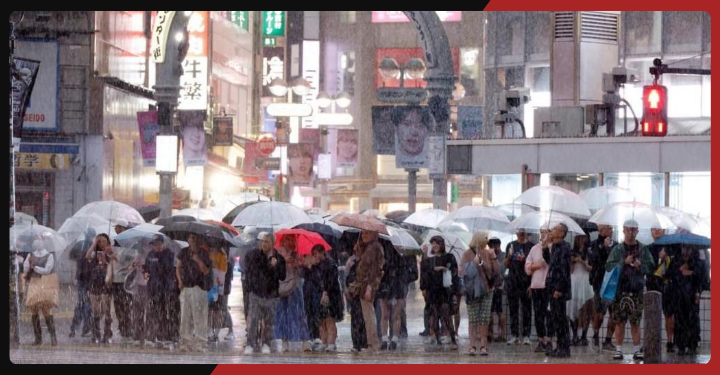
Eastern Japan faced severe weather conditions on Monday as Typhoon Dujuan approached the Pacific coast, bringing heavy rain, powerful winds and increasing risks of flooding and landslides.
Authorities urged more than 1.9 million people to evacuate or prepare to move to safer locations as the storm moved toward the Kanto region. Tokyo and neighbouring prefectures were among the areas placed under heightened alert.
The Japan Meteorological Agency warned that weather conditions could deteriorate rapidly as the typhoon moved closer to the metropolitan area. Officials urged people in vulnerable locations to pay close attention to evacuation information issued by local authorities.
Heavy rain had already affected the Izu Islands and other parts of Japan’s Pacific coast. Some areas received more than 300 millimeters of rainfall over several days, while Izu Oshima recorded more than 600 millimeters in a 24-hour period during the storm’s approach.
The rainfall raised concerns about landslides, flash floods and overflowing rivers. Northern parts of the Izu island chain received the highest-level landslide warning, while several areas in Kanto were placed under lower but still serious warning levels for heavy rain, flooding and landslides.
Weather officials emphasized that people should not underestimate the danger simply because the typhoon’s strongest winds were not directly overhead. Intense rain bands can produce large amounts of rainfall in concentrated areas and can trigger sudden flooding.
In urban areas, authorities warned residents to be particularly careful around underground spaces, flooded roads and drainage channels. Vehicles can become trapped quickly when floodwater rises, making it dangerous for people to attempt to drive through submerged streets.
The storm also caused major disruption to transportation across eastern Japan. Japan Airlines and All Nippon Airways cancelled hundreds of flights combined, while railway operators announced partial or full suspensions on several routes.
The disruption came during Silver Week, a holiday period in Japan when many people travel. The storm therefore affected both residents and visitors, creating congestion and making alternative transportation more difficult in some areas.
Several public events were also affected. The Tokyo Game Show cancelled its Monday programme, while the Asian Games in central Japan postponed an equestrian competition because of the approaching weather system.
Government operations were also affected. Prime Minister Sanae Takaichi delayed her planned departure for New York, where she was scheduled to attend the United Nations General Assembly.
Emergency authorities continued monitoring the storm as it moved northeast. Officials warned that conditions could remain dangerous even after the typhoon moved away because saturated soil can continue to produce landslides and swollen rivers may take time to recede.
Local governments were therefore advising residents to make evacuation decisions based on official warnings rather than waiting for the storm to reach its strongest point.
Japan has extensive experience dealing with typhoons, but officials stressed that the combination of heavy rainfall and strong winds could still create dangerous conditions.
The storm’s approach also highlighted the importance of early evacuation. Moving before roads become flooded or transport services stop can significantly reduce the risks faced by residents in vulnerable locations.
As Typhoon Dujuan continued across eastern Japan, authorities maintained warnings for heavy rain, landslides, flooding and high waves, while emergency services remained on standby.
Journalist Details