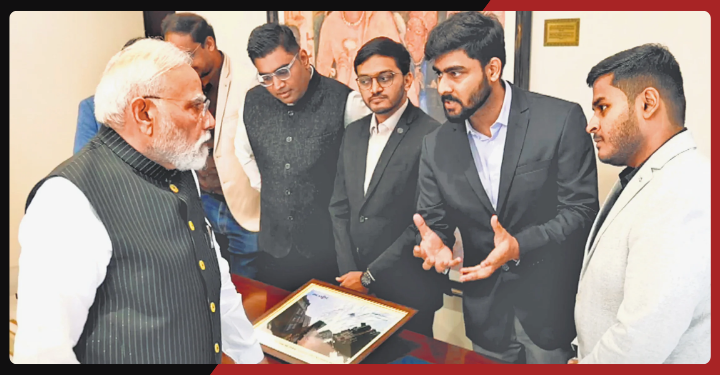
Prime Minister Narendra Modi has called on India’s private space industry to create an ecosystem capable of attracting the world’s best talent, businesses and investment. Speaking to CEOs and founders of 20 space startups, Modi said India should create an “aura” around its space sector so strong that people across the world look towards the country when considering their future in space technology.
The remarks underline a significant shift in India’s space ambitions. For decades, the country’s space programme was primarily associated with the Indian Space Research Organisation. While ISRO remains central to India’s space capabilities, private companies have increasingly emerged as important participants in rocket development, satellite technology, propulsion, data services and other areas.
Modi’s latest message suggests that India now wants to move beyond simply participating in the international space economy. The objective is to establish the country as a destination where global professionals and companies want to work, invest and build new technologies.
The Prime Minister highlighted three major advantages that could help India achieve this objective: cost competitiveness, a large pool of skilled talent and the willingness of Indian entrepreneurs to take risks. He said these strengths could allow India to establish itself quickly in the global space sector.
For startups, however, technological capability alone is not enough. Space companies require long-term investments, specialised infrastructure, research facilities and regulatory certainty. Modi therefore emphasised the importance of maintaining consistency in government decisions.
He told startup founders that entrepreneurs need confidence that policies will not change unpredictably after they commit money and resources to high-risk projects. Such stability, he argued, can encourage more companies to experiment and invest in new technologies.
The private space sector has already shown signs of rapid growth. Government figures released in July said private investment in the sector had exceeded $618 million and 105 authorisations had been issued to private entities.
The government has also reported that India’s space startup ecosystem has expanded to more than 400 startups. This growth has been supported by reforms intended to increase private participation and create new commercial opportunities.
The startups participating in Modi’s interaction represented a wide range of technologies. These included launch vehicles, reusable systems, satellites, propulsion, avionics, space and defence intelligence, debris removal and weather intelligence.
The Prime Minister also stressed that space technology should have a direct impact on everyday life. He encouraged companies to explore applications in agriculture, livestock, dairy and environmental monitoring.
Such applications could help India use satellite data to improve decision-making on the ground. Farmers, for example, could benefit from better information about weather, crops and environmental conditions. Similarly, satellite-based monitoring could support environmental protection and disaster preparedness.
Education was another part of the Prime Minister’s vision. Modi suggested stronger collaboration between space companies and Atal Tinkering Labs to nurture curiosity among young students.
The larger objective is to build a pipeline of talent from schools and universities into India’s growing space industry. If young people see space technology as a viable career, the sector could develop a larger workforce capable of supporting ambitious commercial and scientific projects.
India’s space strategy is therefore increasingly focused on building an ecosystem rather than individual missions. The combination of public institutions, private startups, investors, universities and skilled professionals could determine how far the country rises in the global space economy.
Modi’s “global aura” message captures this ambition: India wants the world not only to notice its space achievements, but also to see the country as a place where the next generation of space technology can be created.
Journalist Details