India has come under renewed scrutiny from Washington after a White House report identified it as one of the major countries within a global network allegedly used to move Chinese-linked products into the United States while reducing exposure to American tariffs.
The report, titled The Great Transshipment Scam, claims that Chinese exporters adapted to US tariffs by changing the routes through which their products reached American consumers. Instead of shipping goods directly from China, exporters could use countries with lower tariff rates as intermediate destinations.
The White House says the practice can involve several methods, including light assembly, finishing, packaging, relabelling, re-invoicing and changes to trade documentation. According to the report, the concern arises when these steps create the appearance that a product originated in a country other than China without undergoing substantial transformation.
India is listed in Tier 1 of the White House classification. The first tier includes major economies and trading platforms where the volume of China-linked trade is significant. The report also names countries and blocs such as Canada, Mexico, Japan, South Korea and the European Union.
The classification is important because it indicates the scale of trade flows Washington believes require closer examination. However, it does not mean that all exports from India to the United States are being treated as Chinese goods or that every Indian business is involved in tariff evasion.
The report’s argument is based partly on changes in international trade patterns following the introduction of US tariffs on Chinese products in 2018. Washington says China’s direct share of the US import market declined after the tariffs, while the combined share of more than 40 countries identified as transhipment-risk locations increased. The White House says the pattern requires greater investigation to determine how much reflects genuine production relocation and how much reflects tariff avoidance.
The economic stakes are considerable. The White House estimates that illegal China-linked transhipment could represent tens of billions of dollars in annual trade. Under one scenario cited in the report, $75 billion of annual illegal transhipment could be associated with hundreds of thousands of displaced American jobs and significant reductions in GDP and federal revenues. The report makes clear that these are model-based estimates rather than direct counts of specific job losses.
The US administration is now looking at technology as a major tool to address the problem. Its proposed “Detective Border” system would use artificial intelligence to examine global trade data and identify unusual routing patterns.
For example, customs authorities could compare a company’s declared production capacity with the amount of goods it exports. If a country suddenly reports a dramatic increase in exports of a product despite having limited manufacturing capacity, officials could investigate whether the goods were actually produced elsewhere.
The system could also examine bills of lading, shipping routes, ownership structures and supply-chain relationships. The White House says the objective is to identify suspicious transactions before they become large-scale tariff-evasion channels.
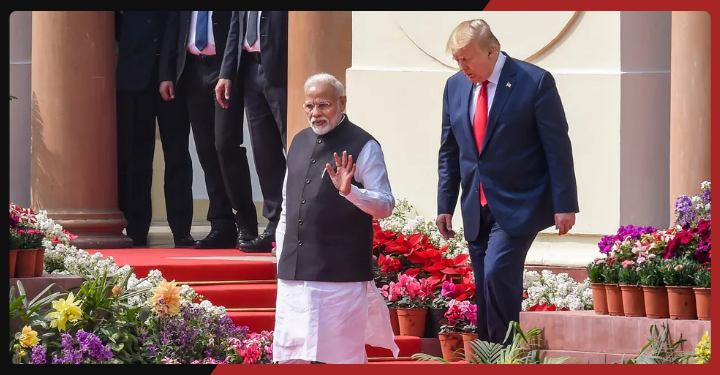
The development comes at a sensitive moment in India-US relations. Trade discussions between the two countries have been accompanied by disagreements over tariffs and other economic issues.
For Indian businesses, the latest US approach could increase the importance of transparent documentation and clear proof of origin. Companies exporting to America may face more questions about where components were sourced, where products were assembled and how much value was added in India.
The White House report therefore represents more than an accusation involving individual shipments. It signals a broader change in US customs policy, with Washington increasingly examining entire supply chains rather than simply the country printed on an export document.
Journalist Details