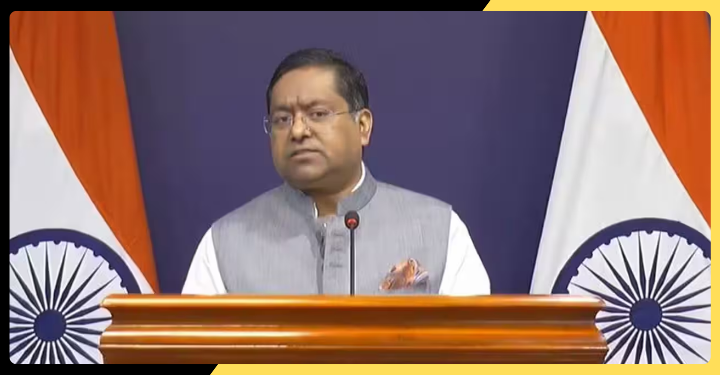
In an era where diplomacy increasingly extends beyond conference rooms and official communiqués, India’s Ministry of External Affairs (MEA) has embraced a new communication tool—social media memes. The Ministry recently shared a meme reinforcing India’s official position on Jammu & Kashmir (J&K) and Ladakh, signalling how digital platforms have become an important arena for public diplomacy and strategic communication.
The post, designed in a light-hearted internet meme format, conveyed a clear and firm message that Jammu & Kashmir and Ladakh are integral parts of India. Though humorous in presentation, the content reflected India’s long-standing diplomatic stance and was intended to counter narratives that question the country’s territorial integrity. The meme quickly attracted widespread attention, generating discussions across multiple social media platforms.
The MEA’s move reflects the growing importance of digital diplomacy in today’s interconnected world. Governments are increasingly recognising that official statements alone may not always reach younger audiences who consume information primarily through social media. By adopting a communication style familiar to internet users, the Ministry sought to ensure that its message was widely seen, understood, and shared.
India has consistently maintained that Jammu & Kashmir and Ladakh are inseparable parts of the country. This position has been reiterated on numerous occasions through parliamentary debates, diplomatic engagements, and official policy statements. Since the constitutional changes of August 2019, which reorganised the former state of Jammu & Kashmir into the Union Territories of Jammu & Kashmir and Ladakh, the government has repeatedly described the move as an internal administrative decision.
The emergence of social media as a major source of information has transformed the way governments communicate. Platforms such as X, Instagram, Facebook, and YouTube allow official institutions to interact directly with citizens without relying exclusively on traditional media channels. This has encouraged ministries across the world to develop content that is both informative and engaging.
Internet memes have become one of the most recognisable forms of online communication. Combining images with brief text, memes can simplify complex topics while making them relatable to large audiences. Their viral nature enables messages to spread rapidly, often reaching millions of users within hours. Governments have gradually begun incorporating this format into public awareness campaigns, tourism promotion, disaster advisories, and diplomatic messaging.
The MEA’s meme demonstrates how humour can be used responsibly to reinforce official policy without diminishing its seriousness. Rather than issuing another lengthy statement, the Ministry delivered a concise visual message that aligned with India’s established diplomatic position. Communication experts say such approaches often improve public engagement because users are more likely to share visually appealing content than traditional press releases.
The timing of the meme also highlights the increasing challenge of combating misinformation online. Incorrect maps, misleading posts, and inaccurate geopolitical claims frequently circulate across digital platforms. Governments worldwide are investing greater effort in responding quickly to such narratives before they gain widespread acceptance. India’s latest communication reflects this broader strategy of responding proactively through digital channels.
Observers note that digital diplomacy has become an essential complement to conventional foreign policy. While negotiations continue through bilateral meetings, international organisations, and diplomatic correspondence, governments must also engage with global audiences online. Public opinion, particularly in the age of social media, can influence international discussions and shape perceptions about national policies.
India’s Ministry of External Affairs has steadily expanded its online presence over the years. Beyond diplomatic announcements, the Ministry regularly shares updates on international visits, humanitarian missions, evacuation operations, cultural exchanges, and major policy decisions. This consistent digital engagement has helped strengthen its visibility among both domestic and international audiences.
The meme generated mixed but largely positive reactions. Many social media users appreciated the Ministry’s willingness to adopt contemporary communication styles, describing the approach as modern and relatable. Others viewed it as evidence that official institutions are adapting to changing media habits while maintaining clarity in their messaging.
Foreign policy analysts believe such initiatives represent an evolution rather than a departure from traditional diplomacy. Formal negotiations remain the cornerstone of international relations, but digital engagement has become an important supporting tool. Governments now recognise that shaping public narratives online is increasingly relevant in an age where information spreads instantly across borders.
Experts also caution that official humour must remain measured and respectful. Diplomatic institutions carry significant responsibility, and every public communication is carefully scrutinised by international audiences. Creative messaging is effective when it reinforces policy without creating ambiguity or undermining institutional credibility.
The MEA’s adoption of meme culture also illustrates the broader transformation occurring within government communication strategies. Rather than viewing social media merely as a platform for announcements, ministries now treat it as a space for dialogue, awareness, and strategic outreach. Visual storytelling enables governments to explain policies in ways that are accessible to audiences with varying levels of political awareness.
As technology continues to reshape the information landscape, digital diplomacy is expected to play an even larger role in international affairs. Governments that successfully combine credibility with innovative communication techniques may be better positioned to engage citizens, counter misinformation, and strengthen their global image.
The Ministry of External Affairs’ latest meme is therefore more than a viral social media post. It represents a modern approach to communicating India’s established position on Jammu & Kashmir and Ladakh while demonstrating how diplomacy is evolving in the digital age. By blending official messaging with contemporary online culture, the MEA has highlighted that even complex geopolitical issues can be presented in formats that resonate with today’s internet-driven audiences.
Journalist Details