A major political confrontation unfolded in New Delhi on October 6 as Leader of Opposition Rahul Gandhi led INDIA bloc leaders in a protest demanding the resignation of Chief Election Commissioner Gyanesh Kumar. The demonstration, centred on concerns over electoral-roll revisions and allegations of “vote chori”, continued for several hours before Delhi Police detained Gandhi, Congress leader Priyanka Gandhi Vadra and several other opposition figures. The leaders were later released.
The protest began with opposition lawmakers marching from the Parliament area towards the Election Commission of India headquarters. Their stated objective was to meet the Election Commission and raise their concerns about the Special Intensive Revision (SIR) of electoral rolls. Opposition parties have argued that changes to voter lists could affect legitimate voters and have demanded greater transparency from the poll body.
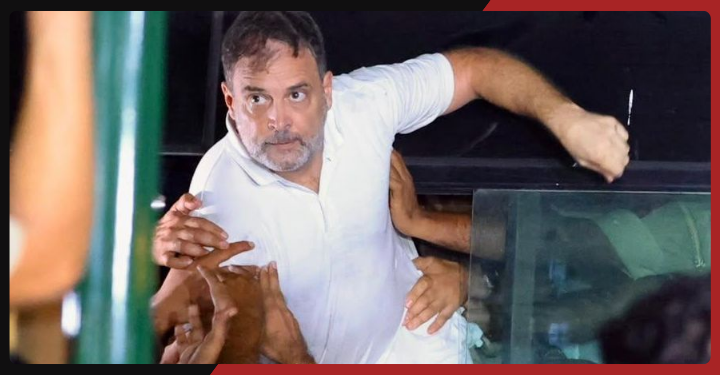
Rahul Gandhi emerged as one of the central figures in the demonstration. During the march, he and other opposition leaders encountered police barricades that had been placed to prevent the protesters from reaching the Election Commission headquarters. Gandhi climbed onto one of the barricades while carrying the national flag, as opposition MPs and supporters raised slogans.
The confrontation did not end when police stopped the march. Instead, the protest shifted to the nearby Akashvani Bhavan premises. Rahul Gandhi and Priyanka Gandhi entered the complex and began a sit-in after the route to the Election Commission remained blocked. Other Congress and opposition leaders subsequently joined them, turning the demonstration into a prolonged standoff with the police.
Gandhi insisted that the opposition leaders would remain at the location until they were allowed to meet the Election Commission. He said the MPs wanted to put their concerns directly before the poll authorities and questioned why elected representatives should not be permitted to meet election officials. His position became the central message of the sit-in.
The Election Commission, however, gave a different account of the dispute over the proposed meeting. In a statement issued after the protest, the poll panel said that no political party had sought an appointment with it until 4 pm on Tuesday. According to the Commission, it was subsequently informed by Delhi Police that a delegation led by Rahul Gandhi wanted to meet the poll body at Parliament House Annexe. The Commission described the proposed venue as unusual because its established protocol provides for meetings with political delegations at the Commission’s premises.
The Commission also said it offered to send a senior official to receive the opposition’s memorandum, but that proposal was declined. It reiterated that political parties can request meetings with the Election Commission and that such meetings are generally scheduled through the established procedure.
For the opposition, however, the issue went beyond the question of a meeting. Congress and its INDIA bloc allies have repeatedly accused the Election Commission of failing to adequately address their concerns regarding electoral-roll changes. They have demanded accountability from Chief Election Commissioner Gyanesh Kumar and have used the phrase “vote chori” to describe what they allege are irregularities in the electoral process. These allegations are political claims and have been disputed by the Election Commission and the BJP.
The BJP strongly criticised the protest. BJP leaders accused the opposition of attempting to undermine constitutional institutions and creating disorder around the Election Commission. The government and ruling party have defended the electoral process and rejected the opposition’s allegations.
As evening approached, the police moved to end the sit-in. Gandhi, Priyanka Gandhi and other leaders were detained after the prolonged standoff at Akashvani Bhavan. According to reports, the detained leaders were taken to Kingsway Camp police lines before being released later that night.
The confrontation has further intensified the political dispute surrounding electoral-roll revisions and the independence of India’s election machinery. For the opposition, Rahul Gandhi’s detention has become another symbol of its campaign against what it describes as threats to electoral transparency. For the government and Election Commission, the episode reflects an opposition effort to politicise an administrative process.
The October 6 events therefore marked another significant escalation between the opposition and the election authorities. With the opposition continuing to demand answers from the Election Commission and the resignation of Gyanesh Kumar, the dispute is expected to remain a major political issue in Parliament and outside it in the days ahead.
Journalist Details