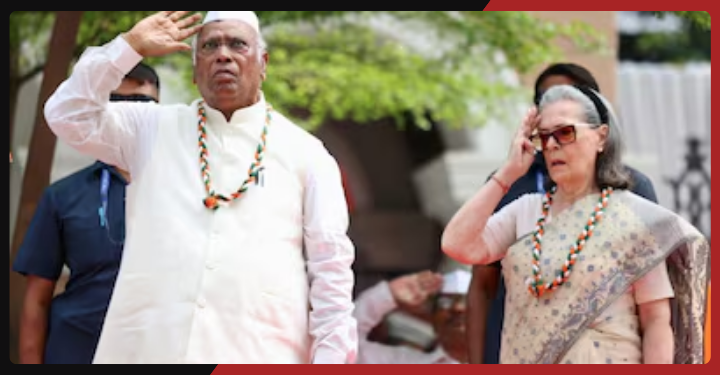
India’s Independence Day celebrations in 2026 were accompanied by an unexpected political controversy involving Sonia Gandhi, Congress president Mallikarjun Kharge and the national song “Vande Mataram.” A video recorded during an Independence Day function at the Congress headquarters in Delhi triggered allegations from the BJP that senior Congress leaders were attempting to interrupt the full rendition of the song. Congress rejected the charge and said the gestures visible in the video were being misunderstood.
The timing of the controversy is significant. August 15, 2026, marks India’s 80th Independence Day, while this year also commemorates 150 years of “Vande Mataram.” The song has been placed at the centre of national celebrations, including the historic decision to have it sung from the Red Fort during the Independence Day ceremony.
At the Congress headquarters, the party organised its own Independence Day programme. Senior leaders, including Sonia Gandhi, Rahul Gandhi and Mallikarjun Kharge, were present. During the rendition of “Vande Mataram,” a video showed Sonia Gandhi and Kharge making hand gestures. Rahul Gandhi was also seen making a gesture later. The footage was subsequently circulated widely on social media.
BJP leaders interpreted those gestures as an indication that the Congress leadership wanted the song to be stopped. That interpretation quickly transformed the video into a political controversy. BJP leaders accused Congress of disrespecting the national song and questioned why such gestures were made during its rendition.
Congress strongly objected to this interpretation. The party said the full version of “Vande Mataram” was performed at its headquarters and denied that anybody had attempted to stop it. Jairam Ramesh said there was no controversy and rejected the allegations being made against the party leadership.
Another explanation provided by Congress was that Sonia Gandhi was seeking a chair for Kharge. According to the party’s account, the gestures were connected to arrangements at the venue rather than the rendition of the song. This explanation was also reported by other media organisations covering the controversy.
The disagreement highlights an important problem in interpreting viral political videos. A short clip may show a gesture but not necessarily reveal the conversation or circumstances surrounding it. Without audio or complete context, viewers may reach different conclusions about what a person was communicating.
The BJP’s argument, however, is based on the visual impression created by the footage. Critics say the gestures appeared to be directed towards people involved in the programme and could be interpreted as a request to stop the rendition. Because the incident occurred during a patriotic song on Independence Day, BJP leaders argued that the matter deserved serious attention.
Congress, meanwhile, has attempted to shift the focus from the political interpretation of the clip to the actual sequence of events. Its leaders point out that “Vande Mataram” was not stopped and that the full rendition took place.
That distinction is important. If the song was completed as Congress claims, then the accusation that the party actually stopped the performance becomes difficult to establish solely from the gestures. On the other hand, opponents may continue to argue that the gestures themselves reflected an attitude towards the performance, regardless of whether the song ultimately continued.
The dispute has become even more politically charged because the national song is receiving extraordinary attention this year. Government plans for the 150th anniversary have placed “Vande Mataram” at the centre of official patriotic programmes. The decision to feature it at the Red Fort for the first time on Independence Day has given the song an especially prominent role in the national celebration.
There is also a broader historical dimension. “Vande Mataram” emerged as an important symbol during India’s freedom struggle. It was written by Bankim Chandra Chatterjee and became deeply associated with the nationalist movement. In 1950, it received national-song status and was accorded equal honour with the national anthem.
Because of that history, political parties frequently treat debates over “Vande Mataram” as debates about patriotism and national identity. The current controversy follows that familiar pattern. BJP leaders have presented the incident as evidence of disrespect, while Congress has described the allegation as politically motivated.
The episode also demonstrates the continuing importance of social media in political communication. The original event lasted considerably longer than the short clip that circulated online. But the shorter version became more powerful because it could be easily shared, viewed and interpreted by millions of people.
For ordinary viewers, the safest conclusion at this stage is to separate what is visible from what is alleged. The video clearly shows Sonia Gandhi making gestures during the rendition. BJP leaders interpreted those gestures as an attempt to stop the song. Congress says the gestures concerned a chair for Kharge and denies any disrespect.
Therefore, describing the incident as a proven “insult” would go beyond what the competing accounts establish. It is more accurate to describe it as a political controversy arising from the interpretation of a viral video.
The issue is likely to remain politically relevant because both sides have strong incentives to continue the debate. For the BJP, national symbols are a powerful political theme. For Congress, allowing an allegation of disrespect towards the national song to stand unanswered could damage its public image.
As the controversy continues, the key question will be whether additional footage or evidence provides greater clarity about the context of the gestures. Until then, the Sonia Gandhi-“Vande Mataram” dispute remains a clash between two competing interpretations of the same event.
Journalist Details