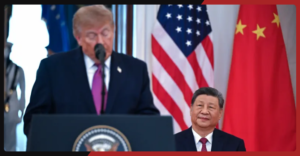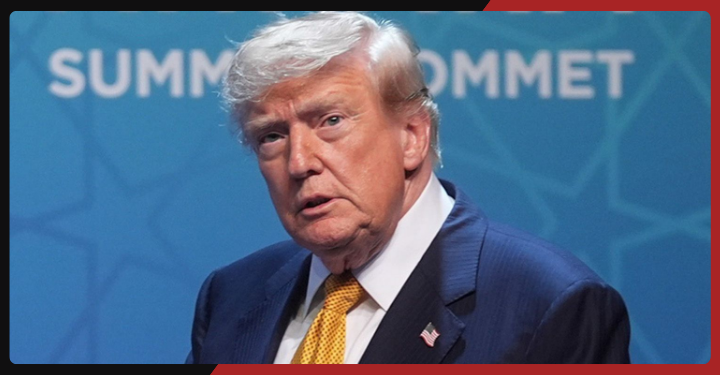
The secret aircraft switch involving Donald Trump during his return from Turkey has emerged as one of the most unusual presidential security operations of the year. What initially appeared to be a routine decision to use an older Air Force One has now been linked to concerns over a possible Iranian threat.
Trump had traveled to Ankara for the NATO summit aboard the newly modified Boeing 747-8 donated by Qatar. The aircraft had been presented as an important addition to the presidential fleet and had undergone extensive work before being used for presidential travel.
But when Trump prepared to leave Turkey on July 8, security officials reportedly changed the plan.
The president publicly boarded the older Air Force One, giving journalists and observers the impression that this would be his aircraft for the next stage of the journey. Instead, he was secretly moved from the aircraft and transported through the airport using a catering vehicle before boarding a smaller C-32A military jet.
The reason was reportedly connected to security concerns involving Iran.
According to recent reporting, Israeli intelligence had warned American officials about a possible Iranian threat to Trump. The intelligence reportedly included a concern that an Iran-linked group could target the president or his aircraft.
However, the latest revelations complicate the story because CIA analysts reportedly had low confidence in the Israeli intelligence. Some American officials apparently believed the warning had not been independently confirmed.
That means the aircraft switch was not necessarily based on a universally accepted intelligence assessment that an attack was imminent.
Instead, the Secret Service appears to have combined several factors.
One was the intelligence warning. Another was concern about the protective capabilities of the newer presidential aircraft. The third was the fact that Trump was leaving a foreign country during a period of heightened tensions with Iran.
The older Air Force One aircraft has been specifically designed to protect the president from a range of threats. It includes sophisticated communications, defensive and electronic systems that distinguish it from a conventional aircraft. Experts have previously pointed out that the newer aircraft, although heavily modified, was not built from scratch for presidential operations.
That difference became especially significant during a high-risk international trip.
The Secret Service did not need to determine with absolute certainty that an attack would occur. Its mission is to protect the president, and that mission naturally encourages caution.
The operation reportedly used deception to prevent anyone outside a small circle from knowing Trump’s actual location. The older Air Force One continued to serve as a decoy while Trump flew separately.
The strategy had an obvious security advantage. If a hostile actor was monitoring airport activity or tracking presidential movements, the visible aircraft could lead them to believe Trump was still aboard it.
Reports said Trump eventually traveled to Britain, where he later appeared publicly in connection with the presidential aircraft operation. He subsequently acknowledged that the Secret Service had directed him to use another aircraft and said he followed its instructions.
The controversy has grown because Secretary of State Marco Rubio and other officials reportedly remained aboard the older aircraft. That has raised questions about how security officials assessed the threat and whether the danger was considered specific to Trump or to the presidential aircraft generally.
If the threat was truly aimed at Trump personally, moving him away from the publicly identified aircraft would make sense. But if the aircraft itself was believed to be the target, leaving senior officials aboard could raise additional questions.
The intelligence debate is equally important.
Foreign intelligence agencies frequently provide warnings to their allies. Israel has extensive intelligence capabilities focused on Iran, making its information particularly relevant to Washington. But US intelligence agencies are expected to test such information against their own sources.
The reported low-confidence assessment shows that this process was not straightforward.
It also illustrates why intelligence warnings should not automatically be treated as established facts. A warning can be important enough to trigger security precautions while still being too uncertain to justify public claims that an assassination attempt was confirmed.
In Trump’s case, officials appear to have chosen the most cautious option.
The result was a complicated operation involving a decoy aircraft, a catering vehicle and a separate military flight.
The incident has also renewed debate about the new presidential aircraft. The Qatar-donated jet was intended to supplement or eventually replace aging presidential aircraft, but questions about its defensive capabilities have become more prominent after the Turkey incident.
Ultimately, the plane switch demonstrates the extraordinary measures required to protect a US president during international travel.
Even when intelligence is uncertain, the cost of taking additional precautions is relatively small compared with the consequences of ignoring a genuine threat.
The most significant unresolved question is therefore not whether officials took the threat seriously—they clearly did—but how reliable the original intelligence was.
Until more information becomes public, the episode remains a combination of an unverified intelligence warning, a genuine security concern and an elaborate presidential protection operation.
Journalist Details