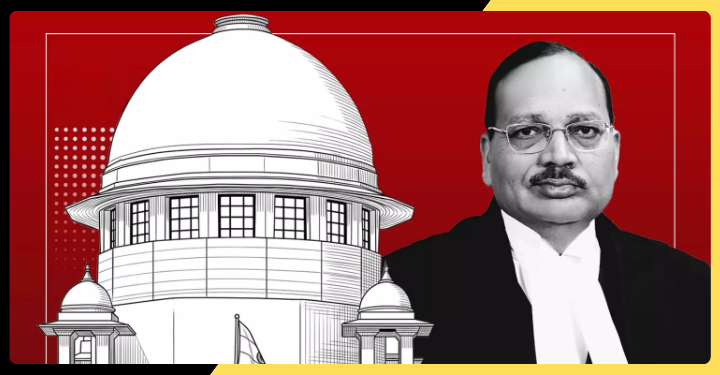
Chief Justice of India Surya Kant has delivered a strong message on the handling of public demonstrations, observing that the mere fact that citizens are agitating cannot justify a lathi-charge or police excesses. The observation was made during the Supreme Court’s hearing of petitions concerning alleged excessive force used against students protesting over examination-related issues.
The bench, headed by CJI Surya Kant and comprising Justices Joymalya Bagchi and V. Mohana, stressed that peaceful and lawful protests enjoy constitutional protection. The court’s comments came against the backdrop of allegations that student protesters faced forceful police action during demonstrations connected with alleged examination irregularities and paper-leak concerns.
The case has raised a broader question about the relationship between public protest and law enforcement. In a democracy, protests are often the most visible way for citizens to express dissatisfaction. Students, workers, farmers and civil society groups frequently take to the streets when they believe their concerns are not being adequately addressed through official channels.
However, protests can also create challenges for authorities, especially when large crowds gather in sensitive areas. Police forces are responsible for maintaining public order, protecting public property and ensuring the safety of citizens. But the Supreme Court has now indicated that the exercise of these responsibilities must be proportionate.
The central principle emerging from the court’s observation is that police action cannot be based solely on the existence of a protest. Authorities must examine the actual circumstances. Is the protest peaceful? Are protesters violating restrictions? Is there a genuine threat to life or property? Are police personnel being attacked? These questions become important before force is used.
The court also emphasised the need for self-discipline. According to the observations, democracy requires discipline not only from protesters but also from police personnel. Protesters must avoid violence, while the police must use restraint and follow proper procedures.
Another significant aspect of the hearing was the court’s concern for injured police officers. The bench observed that injuries to individuals, whether students or police personnel, are equally concerning. This indicates that the court is attempting to examine the issue from both sides rather than viewing the matter only through the allegations made by protesters.
The Supreme Court also raised the issue of proper equipment for police personnel deployed to control demonstrations. If police officers are sent to manage large protests without adequate protective equipment, they too can face serious risks. The court indicated that the government may need to explain whether police personnel had sufficient protective gear.
The proceedings could eventually result in nationwide guidelines or uniform protocols for dealing with protests. Such guidelines could define standards for warnings, crowd management, use of force, documentation and independent investigations.
For students and other citizens, the court’s observation reinforces the importance of peaceful protest as a democratic right. For law enforcement agencies, it highlights that maintaining order does not automatically mean using force.
The Supreme Court’s message is therefore clear: public order is important, but so is the right to dissent. A democratic society must find a balance between the two.
Journalist Details