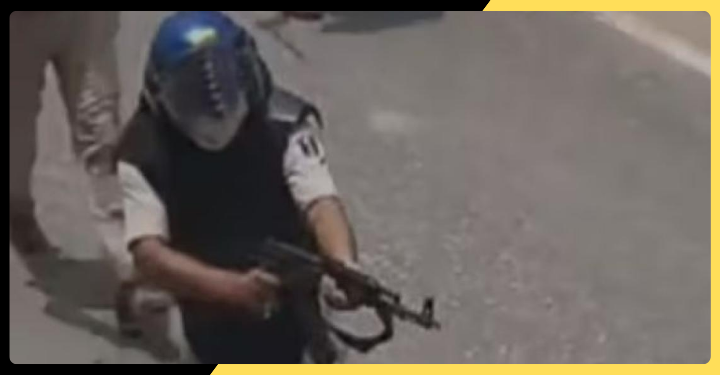
The suspension of a Bihar policeman after a viral video showed him allegedly using an AK-47 during a student protest has not ended the controversy. Instead, it has raised a more difficult question: Is the entire responsibility limited to the officer seen in the video, or should investigators also examine the chain of command behind the police operation?
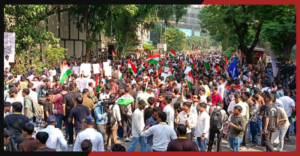
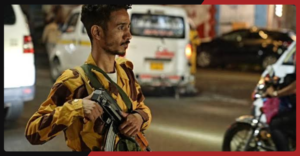
The incident occurred in Siwan during the Bihar Bandh on July 25. The shutdown was linked to student protests over alleged irregularities surrounding the NEET-UG examination. A video that spread rapidly on social media appeared to show a constable from the District Intelligence Unit carrying an AK-47 and allegedly firing during the protest. The visuals generated widespread outrage and prompted demands for immediate action.
The Bihar Police responded by suspending the constable. Siwan SP Puran Kumar Jha confirmed the suspension and said departmental proceedings had begun. An inquiry was also ordered to determine the circumstances surrounding the use of the rifle. The officer’s suspension demonstrates that authorities considered the video serious enough to require immediate disciplinary action.
But suspension is only the first stage of accountability. The larger investigation must establish what happened on the ground. Was the officer acting on his own? Was he part of a formally deployed armed team? Did a senior officer issue an order? Was the firing intended as a warning, fired into the air, or directed towards a specific area? These questions will determine the legal and administrative consequences.
The controversy is intensified by conflicting claims about the protest itself. Some reports describe clashes between demonstrators and police, while others focus on the alleged use of excessive force against students. The authorities have stated that no one was injured in the firing according to the Siwan SP, while other reports have referred to injuries during the broader confrontation. The investigation will need to separate verified facts from political claims and social-media narratives.
This is important because public order operations are rarely the responsibility of a single individual. Police deployments usually involve planning, instructions, supervision and communication between officers. If an officer uses a firearm in a crowded protest, investigators may need to determine whether supervisors were aware of the weapon’s deployment and whether adequate instructions had been issued.
The episode has also triggered a broader discussion about accountability in government institutions. Critics argue that punishing one constable may not be sufficient if there were failures in command or supervision. Others caution against assuming wrongdoing before the facts are established, pointing out that police officers may face genuine threats during violent protests.
The political dimension has made the matter even more sensitive. Opposition leaders have used the incident to attack the government’s handling of student demonstrations and to question the broader response to the NEET controversy. The incident has therefore become part of a national conversation about whether public protests are being handled through negotiation and restraint or through increasingly aggressive policing.
For the authorities, the challenge is now to conduct a transparent and credible investigation. The public will expect clarity on the weapon used, the ammunition involved, the orders given, the sequence of events and the identities of anyone injured. If the inquiry is seen as incomplete or politically influenced, the controversy could grow further.
The Siwan incident has therefore become much bigger than a single viral video. It has raised fundamental questions about command responsibility, police training, the use of firearms and the limits of force during democratic protests. The final findings will determine whether the suspension is seen as meaningful accountability or merely an initial response to public outrage.
Journalist Details