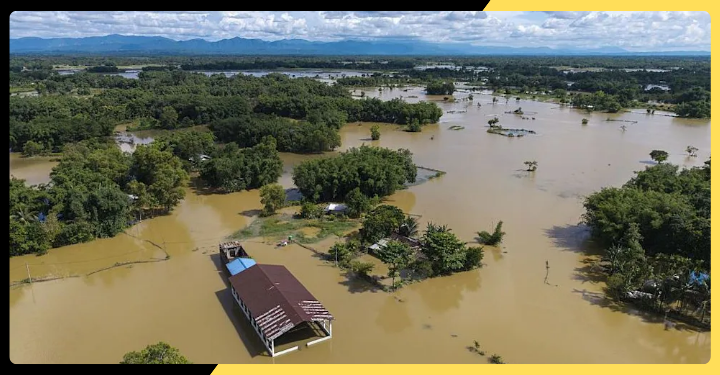
Every year, the arrival of the monsoon brings both hope and fear to Assam. While seasonal rainfall is essential for agriculture, increasingly intense downpours have transformed annual floods into recurring humanitarian disasters. This year’s devastating floods have once again raised urgent questions about why Assam’s flood crisis appears to be growing more severe with each passing year.
The primary reason lies in geography. Assam is dominated by the mighty Brahmaputra River, one of Asia’s largest river systems. Originating in the Himalayas, the river carries enormous volumes of water through the state before flowing into Bangladesh. During the monsoon, heavy rainfall across the Himalayan region dramatically increases river discharge, often causing the Brahmaputra and its tributaries to overflow.
However, natural geography alone no longer explains the scale of modern flooding. Scientists increasingly point to climate change as a major contributing factor. Rising global temperatures allow the atmosphere to hold more moisture, leading to heavier and more concentrated rainfall events. Instead of moderate rainfall spread over several weeks, Assam now experiences intense cloudbursts that overwhelm rivers and drainage systems.
Deforestation has further worsened the situation. Forests naturally absorb rainwater and reduce surface runoff. As tree cover declines due to human activity, more rainwater flows directly into rivers, causing water levels to rise more quickly. Soil erosion also increases, sending huge amounts of sediment into river channels.
The Brahmaputra carries one of the world’s highest sediment loads because it flows through young Himalayan mountains. Over time, deposited sediment raises the riverbed, reducing the river’s capacity to carry floodwater. As a result, even normal monsoon flows can lead to overflowing banks and widespread flooding.
Wetland destruction has created another major challenge. Assam’s wetlands once acted as natural flood buffers, storing excess water during heavy rainfall. Urban expansion, construction, and land conversion have significantly reduced these wetlands, leaving fewer natural spaces to absorb floodwaters.
Rapid urbanisation has also contributed to the crisis. Expanding towns and cities replace natural landscapes with roads, buildings, and concrete surfaces that prevent rainwater from soaking into the ground. Poor drainage systems often become overwhelmed during heavy rainfall, causing severe urban flooding.
Climate experts also warn that extreme weather events are becoming increasingly unpredictable. Rainfall patterns have become less consistent, making it harder for authorities and communities to prepare for flood emergencies. Sudden increases in river levels leave little time for evacuation.
The human cost of these floods remains enormous. Thousands of families lose homes every year, farmers suffer repeated crop failures, and businesses experience heavy financial losses. Children miss weeks of school, while healthcare systems struggle to prevent disease outbreaks in overcrowded relief camps.
Wildlife is equally affected. Assam’s famous Kaziranga National Park frequently experiences seasonal flooding, forcing rhinos, elephants, deer, and other animals to migrate to higher ground. While flooding is a natural part of the park’s ecosystem, increasingly severe floods increase the risk of animal deaths and human-wildlife conflict.
Governments have invested in embankments, flood forecasting, early warning systems, and disaster response capabilities. These measures have helped save lives, but experts argue that long-term solutions require a more comprehensive approach. Sustainable river management, wetland conservation, afforestation, stronger building standards, and improved urban planning are all considered essential.
Community awareness is also critical. Local disaster preparedness programmes, evacuation drills, emergency shelters, and public education campaigns can significantly reduce casualties during future floods. Modern technology, including satellite monitoring and improved weather forecasting, can provide earlier warnings to vulnerable communities.
The recent floods serve as another reminder that climate adaptation is no longer optional. Assam’s future depends not only on responding to disasters but also on reducing their impact through better planning, environmental conservation, and resilient infrastructure.
Although floods have shaped Assam’s history for centuries, their growing intensity reflects a changing climate and increasing environmental pressures. Addressing these challenges will require coordinated action from governments, scientists, communities, and international partners. Only through long-term investment and sustainable development can Assam hope to reduce the devastating impact of future floods while protecting both people and nature.
Journalist Details